
Here’s a scenario I’ve seen play out more times than I can count: someone checks their bank balance, sees a healthy number, and feels financially fine — right up until three bills hit on the same day and suddenly they’re overdrawn. The account balance told them nothing about timing. Understanding what cash flow actually is — not just how much money you have, but when it moves in and out — is what would have caught that problem weeks in advance.
What Cash Flow Actually Means for Your Money
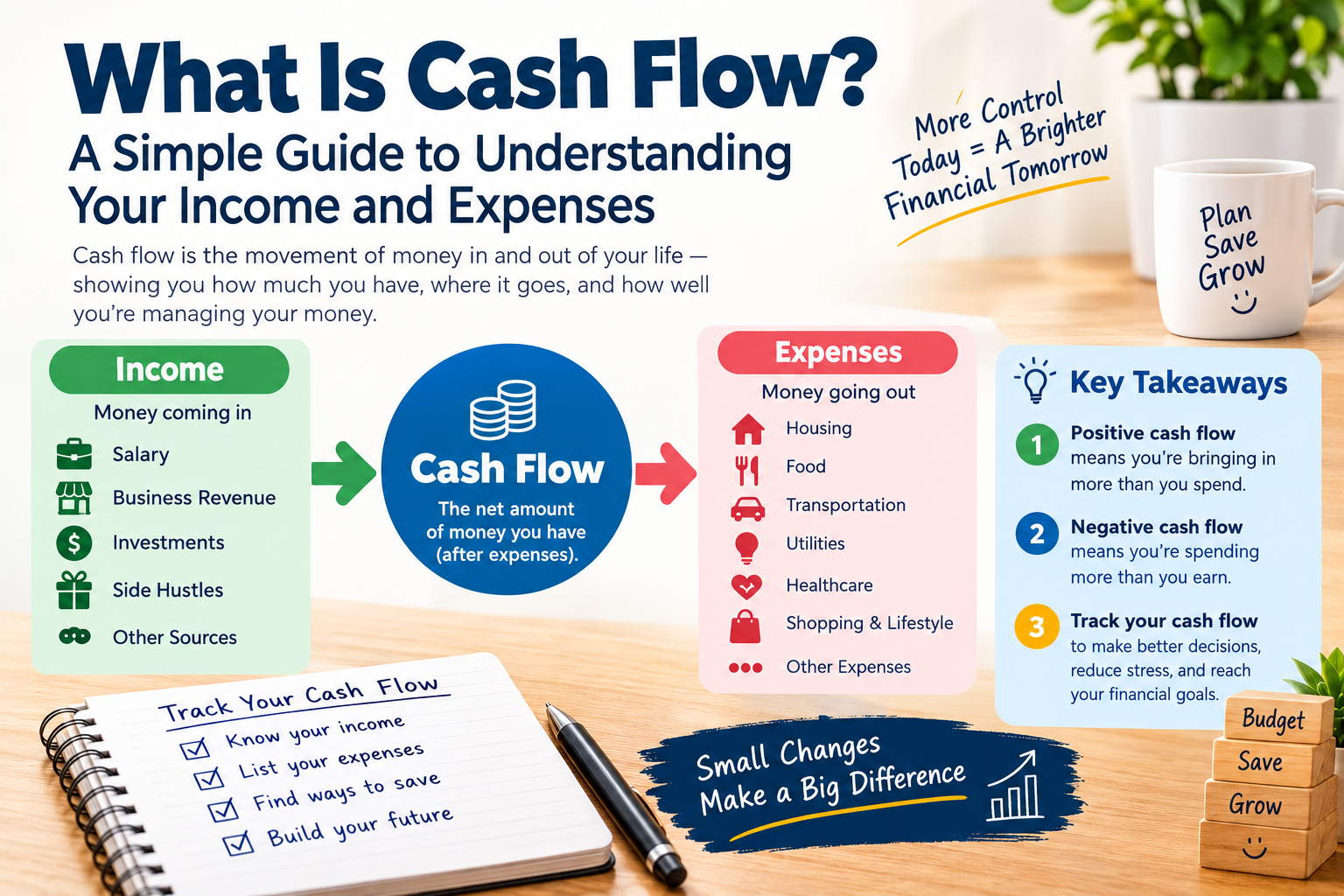
Cash flow is the movement of money into and out of your finances over a specific period — typically a month. It’s not a snapshot (like your account balance); it’s a record of motion: what came in, what went out, and what was left over.
Cash Flow vs. a Budget: What’s the Difference?
A budget is a plan for how you intend to spend and save. Cash flow is what actually happened — or is happening in real time — regardless of what the plan said. You can have a perfectly reasonable budget on paper and still run into cash flow problems if income and expenses don’t land in your account in the order you expected.
Positive, Negative, and Break-Even Cash Flow
- Positive cash flow — more money came in than went out during the period.
- Negative cash flow — more money went out than came in, meaning you dipped into savings or credit to cover the gap.
- Break-even cash flow — income and expenses were roughly equal.
None of these are inherently “good” or “bad” in isolation — a month of negative cash flow because you made a planned large purchase from savings is very different from negative cash flow because your expenses have quietly crept above your income every month.
[Internal Link: “related article about how to create a monthly budget that actually works”]
Why Tracking Cash Flow Matters More Than Just Checking Your Balance
Your Account Balance Can Be Misleading
A balance is a single number at a single moment. It doesn’t tell you that three of your biggest bills are due in the next four days, or that your paycheck doesn’t land until after they’re withdrawn. In my experience, this exact gap — a balance that looks fine but doesn’t reflect what’s about to happen — is where overdraft fees and missed payments most often come from.
Cash Flow Reveals Timing Problems, Not Just Amount Problems
You might earn plenty to cover your expenses over the course of a month, but if your rent is due on the 1st and your paycheck doesn’t arrive until the 3rd, you have a timing problem, not an income problem. Tracking cash flow surfaces these mismatches before they become overdrafts.
[Internal Link: “related article about checking accounts versus savings accounts”]
How to Calculate Your Personal Cash Flow: Step-by-Step
Listing All Income Sources
Start by listing every source of money coming in during a typical month: your paycheck (after taxes), side income, government benefits, or any other recurring deposits. Use actual take-home amounts, not gross figures.
Listing All Expenses (Fixed and Variable)
Break expenses into two categories:
- Fixed expenses — rent or mortgage, loan payments, subscriptions, insurance premiums — amounts that stay roughly the same each month.
- Variable expenses — groceries, gas, dining out, entertainment — amounts that fluctuate month to month.
Don’t forget irregular expenses that don’t occur monthly but still need to be accounted for, like car maintenance, annual subscriptions, or holiday spending — these are the categories most cash flow trackers miss.
Doing the Math
The formula is simple:
Net Cash Flow = Total Income − Total Expenses
If the result is positive, you had money left over. If it’s negative, you spent more than you brought in during that period — worth investigating whether that was a one-time event or a recurring pattern.
[Internal Link: “related article about emergency funds and how much to save”]
Common Mistakes People Make When Tracking Cash Flow
Forgetting Irregular Expenses
The most common mistake: calculating cash flow using only predictable monthly bills and ignoring the quarterly insurance payment, annual subscription renewal, or once-a-year car registration fee. These expenses don’t disappear just because they’re irregular — they just show up as a surprise later.
Confusing Available Balance With Actual Cash Flow
Honestly, most people get this wrong: they treat whatever’s currently in their checking account as “available” money, without accounting for bills that are about to hit. Real cash flow tracking looks forward, not just at the current balance.
Not Separating One-Time Events From Patterns
A single month of negative cash flow because of an unexpected car repair isn’t necessarily a problem. A pattern of negative cash flow every month is. Treating every negative month as equally alarming — or equally fine — misses the point of tracking this in the first place.
Expert Tips for Improving Your Cash Flow
On the Income Side
- Time large expenses around your pay schedule where possible — shifting a bill’s due date by even a few days can eliminate a recurring timing gap.
- Build a small buffer in checking beyond your exact bill total, so timing mismatches don’t turn into overdrafts.
On the Expense Side
- Review subscriptions and recurring charges quarterly — these are the expenses most likely to quietly accumulate without you noticing.
- Set aside a small monthly amount for irregular expenses (car maintenance, annual fees) in a separate account, so they don’t create a cash flow shock when they hit.
- Track cash flow monthly, not just once a year — patterns are much easier to catch in near real-time than in a year-end review.
- Use free cash flow tools or a simple spreadsheet rather than relying on memory or your account balance alone.
- Flag negative cash flow months immediately and ask whether it was a one-time event or a sign that expenses have crept above income.
Comparison Table: Ways to Track Personal Cash Flow
| Feature | Manual Spreadsheet | Budgeting App | Bank’s Built-In Tools | Pen-and-Paper Tracking |
|---|---|---|---|---|
| Setup effort | Moderate | Low | Very low (already exists) | Very low |
| Automatic updates | No | Often yes | Sometimes (varies by bank) | No |
| Forward-looking (upcoming bills) | Only if manually added | Often built-in | Rarely | No |
| Best for | Customization and detail | Convenience | Quick balance checks | Simple, distraction-free tracking |
| Cost | Free | Free to paid | Free | Free |
Who Needs to Track Cash Flow Closely (and Who Can Check In Less Often)
Tracking cash flow closely matters most for anyone living close to their monthly income, managing multiple bills with different due dates, dealing with variable income (freelancers, gig workers, commission-based earners), or trying to build better spending awareness for the first time.
A lighter touch may be enough for people with a stable income comfortably above their expenses and an established buffer already in checking — in that case, a monthly glance rather than constant tracking is often sufficient, though it’s still worth revisiting periodically as circumstances change.
Conclusion
Cash flow is about motion, not just balance — understanding what comes in, what goes out, and when each of those things happens is what actually prevents the overdraft-inducing surprises that a bank balance alone can’t warn you about. Start by listing your income and expenses for a single month, run the simple math, and pay attention to timing as much as amount. If you’ve never tracked this before, this month is as good a time as any to start.
3. FAQ Section
Q1: What’s the difference between cash flow and net worth?
Cash flow measures the movement of money over a period of time (monthly income minus expenses), while net worth is a snapshot of everything you own minus everything you owe at a single point in time. Both matter, but they answer different questions about your finances.
Q2: How do I calculate my monthly cash flow?
Add up all your income sources for the month, subtract your total expenses (fixed and variable), and the result is your net cash flow. A positive number means you had money left over; a negative number means you spent more than you brought in.
Q3: What does negative cash flow mean?
Negative cash flow means more money went out than came in during that period. In my experience, it’s worth checking whether it was a one-time event (like an unexpected repair) or a recurring pattern before deciding how concerned to be.
Q4: Is cash flow the same thing as a budget?
Not quite — a budget is your plan for spending and saving, while cash flow is what actually happened. You can have a solid budget on paper and still experience cash flow problems if income and expenses don’t line up in the order you expected.
Q5: Why does my bank balance look fine but I still run into overdrafts?
Your balance is a snapshot of one moment — it doesn’t account for bills about to be withdrawn or a paycheck that hasn’t arrived yet. Honestly, this is one of the most common reasons overdrafts happen even to people who seem to have “enough” money.
Q6: How often should I track my cash flow?
Monthly tracking tends to work well for most people, since patterns are easier to catch before they become a habit. Anyone with variable income or tight monthly margins may benefit from checking more frequently, even weekly.
Q7: What are irregular expenses, and why do they matter for cash flow?
Irregular expenses are costs that don’t occur every month — car registration, annual subscriptions, holiday spending — but still need to be accounted for. Forgetting them is one of the most common cash flow tracking mistakes, since they show up as a surprise instead of a planned expense.
Q8: Can a household have positive cash flow and still be in financial trouble?
Yes — positive cash flow doesn’t automatically mean things are going well if it’s only achieved by ignoring debt payments or delaying necessary expenses. Cash flow is one useful signal, not the entire financial picture.
Q9: What’s the easiest way for a beginner to start tracking cash flow?
Starting with a simple spreadsheet or even pen and paper for one month is usually enough to see the pattern — you don’t need a sophisticated tool to get useful insight right away.
Q10: How is business cash flow different from personal cash flow?
The core concept is the same — money in minus money out over a period — but business cash flow typically involves more complex categories, like accounts receivable and payable, that don’t usually apply to personal finances in the same way.