
Let’s start with a gap that’s hard to ignore. According to FDIC data, the national average savings account rate was about 0.38% APY as of July 2026. Meanwhile, the top high-yield savings account Bankrate listed in mid-September paid 4.10% APY.
On $10,000, that’s roughly $38 a year versus roughly $410. Same money, same bank insurance, very different results. And that’s before you factor in the effect that makes this whole topic matter: compounding.
The distinction between simple interest vs. compound interest sounds like a school math lesson. In practice, it decides how fast your savings grow and how fast your debt does too. This guide explains both in plain English, with worked examples, so you can spot which one you’re dealing with and what to do about it.
[AUTHOR EXPERIENCE: If true, add 2–3 sentences about a real moment when you first understood compounding, whether on savings or debt. Otherwise delete this line.]
What Are Simple and Compound Interest?
Interest is the price of using money. If you borrow, you pay it. If you save or lend, you earn it. The two methods differ in one key way: what the interest is calculated on.
Simple interest
Simple interest is calculated only on the original amount, called the principal. Interest you’ve already earned or been charged doesn’t earn more interest.
The formula is:
Interest = Principal × Rate × Time
So $1,000 at 5% simple interest earns $50 a year, every year. After 10 years, that’s $500 in interest, for a total of $1,500. It’s a straight line.
Compound interest
Compound interest is calculated on the principal plus any interest that has already been added. That’s why people call it “interest on interest.”
The formula is:
A = P × (1 + r/n)^(n×t)
Where P is the principal, r is the annual rate as a decimal, n is how many times per year interest compounds, and t is the number of years.
Using the same $1,000 at 5% compounded annually, you’d have about $1,628.89 after 10 years. That’s $128.89 more than the simple-interest result, for the same rate and the same time.
The one-sentence difference
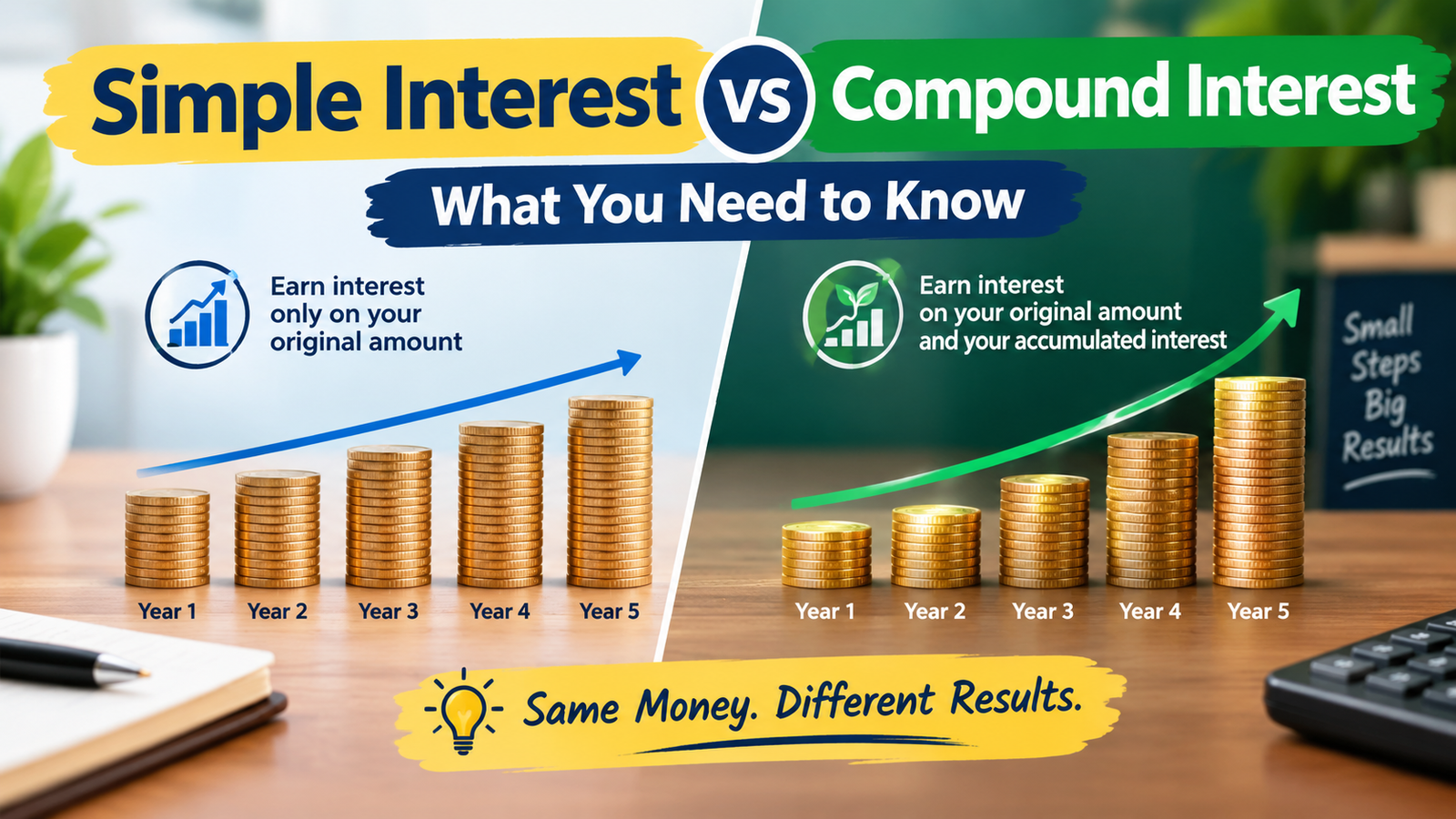
Simple interest grows in a straight line. Compound interest grows in a curve that gets steeper over time.
One source that explains this well is the federal student loan servicer Edfinancial, which describes the difference this way: simple interest is figured only on the principal balance, not on previously accrued interest.
APR vs. APY
You’ll see two acronyms constantly, and they’re easy to mix up.
- APR (annual percentage rate) is the yearly rate on a loan or credit card. For credit cards, Experian notes that the APR and the interest rate are the same thing. For installment loans, the APR may also factor in fees like origination charges.
- APY (annual percentage yield) is used for deposit accounts and reflects the effect of compounding.
That’s why a savings account advertising 4.10% APY and a loan advertising 4.10% APR aren’t directly comparable numbers. One includes compounding and the other has its own rules. [VERIFY: confirm current federal disclosure rules for APR and APY (Truth in Lending and Truth in Savings) before publishing.]
[Internal Link: “APR vs. APY: what’s the difference?”]
Why the Difference Matters: The Real Stakes
Compounding is neutral. It works for you when you’re the saver and against you when you’re the borrower. Here’s where each shows up.
On the saving side
The FDIC-based figure above tells the story. Where you keep your cash changes the rate, and compounding then multiplies the difference over time.
Here’s a hypothetical to make it concrete. If $10,000 stayed in an account paying 0.38% APY for 10 years, it would grow to about $10,387. In an account paying 4.10% APY, it would grow to roughly $14,945. That’s a difference of more than $4,500 on the same deposit.
That comparison assumes the rates hold steady, which they won’t. Deposit rates move with the broader rate environment. But the direction of the lesson holds.
On the borrowing side
The CFPB explains how credit cards work: each day’s interest is added to the previous day’s balance, so interest compounds daily. Cards convert the annual rate to a daily rate by dividing by 360 or 365, depending on the issuer.
Put simply, if you carry a balance, you’re paying interest on interest, every day.
Where it gets confusing: student loans
Federal student loans are a good example of why labels can mislead. Most student loans, including federal ones, accrue simple interest, according to Edfinancial’s servicer materials. Interest accrues daily on the principal, including during grace periods, deferment, and forbearance.
But there’s a catch called capitalization. Accrued interest is usually capitalized, meaning added to the principal, when the loan enters repayment. After that, interest accrues on a bigger principal. So the loan is technically simple interest, but capitalization can produce a compounding-like effect. [VERIFY: capitalization rules for federal loans have changed over time. Check studentaid.gov for the current rules before publishing.]
[Internal Link: “how student loan interest works”]
Why time is the multiplier
Compounding is slow at first and then dramatic. The longer the money is left alone, the more the curve bends. That’s why a lot of financial advice boils down to two ideas: start early, and don’t interrupt the growth.
How Each Type Works: A Step-by-Step Breakdown
Let’s put real numbers on it.
Step 1: Simple interest, calculated
Take $10,000 at 5% simple interest for 10 years:
- Interest = $10,000 × 0.05 × 10 = $5,000
- Total = $15,000
Step 2: Compound interest, calculated
Same $10,000, same 5%, same 10 years, compounded annually:
- A = $10,000 × (1.05)^10 = $16,288.95
- Interest earned = $6,288.95
So compounding added about $1,289 over simple interest in this example.
Step 3: See how the gap widens with time
Here’s the same $10,000 at 5%, simple vs. annual compounding:
| Years | Simple interest total | Compound interest total | Difference |
|---|---|---|---|
| 5 | $12,500.00 | $12,762.82 | $262.82 |
| 10 | $15,000.00 | $16,288.95 | $1,288.95 |
| 20 | $20,000.00 | $26,532.98 | $6,532.98 |
| 30 | $25,000.00 | $43,219.42 | $18,219.42 |
Look at the 30-year row. The simple-interest total is $25,000. The compounded total is nearly $43,219. Same rate. The only thing that changed is whether interest earned interest.
Step 4: Understand compounding frequency
Interest can compound annually, monthly, or daily. More frequent compounding produces slightly more. Here’s $10,000 at 5% for 10 years:
| Compounding | Ending balance |
|---|---|
| Annually | $16,288.95 |
| Monthly | $16,470.09 |
| Daily | $16,486.65 |
Going from annual to daily adds about $198 over ten years. That’s real, but small compared with the effect of a higher rate or a longer time. In my view, people fixate on frequency when they should be looking at the rate and time.
Step 5: Convert to an apples-to-apples rate
A 5% rate compounded monthly works out to an effective annual yield of about 5.12%. Compounded daily, it’s roughly 5.13%. The formula is:
Effective annual rate = (1 + r/n)^n − 1
That’s what APY captures for deposit accounts. If you’re comparing two savings products, compare APYs.
Step 6: Use the Rule of 72
For a quick mental estimate of how long it takes money to double at a compounding rate, divide 72 by the rate:
- At 6%: 72 ÷ 6 = about 12 years
- At 9%: 72 ÷ 9 = about 8 years
It works on debt too. It’s a rough shortcut, but it’s surprisingly accurate at typical rates. At 5%, the rule says 14.4 years, and the exact answer is about 14.2.
Step 7: See how simple daily interest works on a loan
Student loan servicers describe a daily formula: unpaid principal × interest rate ÷ 365 (some materials use 365.25). On a $10,000 balance at 6.5%, that’s about $1.78 a day, or roughly $650 a year. That’s a hypothetical illustration, not a rate quote.
Now suppose interest capitalizes after four years of school. With $2,600 of accrued interest added, the principal becomes $12,600. Annual interest at 6.5% is now about $819, instead of $650. That’s the “compounding-like” effect of capitalization.
The Three-Question Interest Check
Here’s the quick framework I’d use whenever you see an interest rate:
- Am I the saver or the borrower? Compounding helps one and hurts the other.
- What’s the method? Is it simple interest, daily simple interest on a declining balance, or compounding? Check the agreement.
- What’s the time horizon? The longer it runs, the more the method matters.
If you can answer those three, you understand the deal.
[Internal Link: “how compound interest works for long-term investing”]
Common Interest Mistakes (and How to Avoid Them)
1. Assuming “simple” and “compound” are just labels. They change the total cost or growth materially, especially over long periods.
2. Ignoring compounding on debt. A card balance doesn’t just sit there. The CFPB explains that interest is added to the daily balance, so it compounds. Paying only the minimum leaves the compounding running.
3. Comparing APR to APY. They aren’t measuring the same thing. Compare like with like: APY to APY for savings, APR to APR for loans.
4. Focusing on compounding frequency instead of rate. As the table showed, daily vs. annual is a small effect compared with the rate itself.
5. Believing the famous quote. You’ve probably seen compound interest called the “eighth wonder of the world” and credited to Einstein. The attribution is widely repeated but of doubtful origin, so I’d skip it in anything you publish. [VERIFY before including or excluding.]
6. Assuming a “simple interest” loan can’t grow. Student loan capitalization is the classic example. Unpaid interest can be added to principal, increasing future interest. Ask your servicer when capitalization happens.
7. Leaving savings in a near-zero account. If your money is earning far below what’s available, the compounding is working at a tiny rate. Shop around, staying within insured accounts.
8. Assuming returns are guaranteed. Savings interest rates are set by the bank and can change. Investment returns aren’t fixed at all. Any long-term projection is an illustration, not a promise.
[AUTHOR EXPERIENCE: Add a real mistake you or someone you know made with interest, if you have one.]
Expert Tips & Advanced Strategies
1. Pay credit card balances early in the cycle. Because issuers typically charge interest on the average daily balance, a payment made earlier reduces the balance for more days. Paying in full each month avoids interest altogether.
2. Prioritize the highest-rate compounding debt. If you’re deciding where extra money goes, the debt that compounds daily at the highest rate is usually the costliest. Check your own agreements to confirm.
3. Front-load extra payments on amortizing loans. On loans where interest is calculated on the remaining balance, early payments are mostly interest, so extra principal early reduces the balance that future interest is based on. [VERIFY: confirm how your specific loan applies extra payments; ask the servicer to apply them to principal.]
4. Prioritize time over amount when you’re saving. Starting earlier usually beats starting bigger, as the example below shows. If you can only start small, start anyway.
5. Automate contributions. Compounding needs consistency. Automatic transfers keep the curve going without willpower.
6. Compare APYs when shopping for savings. And check whether a promotional rate expires, whether there are minimums, and whether the account is FDIC- or NCUA-insured.
7. Read the compounding clause in loan agreements. Look for how interest is calculated, when it capitalizes, and whether there’s a daily periodic rate. It’s usually in the terms.
[Internal Link: “high-yield savings accounts explained”]
A Worked Example, and Who This Is (and Isn’t) For
An illustrative example
The following is a hypothetical scenario to show the math. It isn’t real people’s results. It assumes a constant 7% annual return compounded monthly, which real investments don’t guarantee.
Imagine two savers who each put $200 a month into an account.
- Saver A starts 30 years before retirement.
- Saver B starts 20 years before retirement.
| Saver A | Saver B | |
|---|---|---|
| Years contributing | 30 | 20 |
| Total contributed | $72,000 | $48,000 |
| Ending balance (approx.) | $243,994 | $104,184 |
| Growth from compounding (approx.) | $171,994 | $56,184 |
Saver A contributed $24,000 more than Saver B, but ended up with roughly $139,800 more. The extra ten years gave compounding more room to work.
The point isn’t the exact numbers. It’s that time does much of the heavy lifting, and that a delay costs more than it feels like it does.
Who should use this knowledge
This is especially useful if you:
- Are choosing between savings accounts, CDs, or other deposit products
- Carry a credit card balance and want to understand how it grows
- Have student loans and want to know what “accrues” and “capitalizes” mean
- Are starting to save or invest and want to see why starting early matters
Who it may not fit
- If you’re focused on immediate cash flow, compounding math may be secondary to covering essentials. Stabilize your budget first.
- If you’re in a debt spiral, the priority is often to reduce or restructure the debt. Consider nonprofit credit counseling [VERIFY: link to reputable resources].
- If you’re thinking of investing based on projected returns, remember these examples assume constant rates. Actual returns vary and can be negative.
- If your situation is complex, such as a business loan, variable-rate debt, or tax questions, consider talking with a qualified professional.
This is general educational information, not personalized financial advice.
Conclusion
Here’s what I’d want you to take away. Simple interest is calculated on the principal alone. Compound interest is calculated on the principal plus the interest already added. That one difference is why savings can snowball and why debt can too.
Check three things whenever you see a rate: whether you’re saving or borrowing, how the interest is calculated, and how long it will run. Compare APY to APY and APR to APR. Prioritize a higher rate and more time over obsessing about compounding frequency. And remember that if you’re carrying a balance on a compounding debt, time is working against you.
You don’t need advanced math. You need to know which direction the curve is pointing.
Your next step: Pull up one account or loan you have right now and find two things in the agreement: the interest rate and how it’s calculated. If you can’t find the method, call and ask. That single check will tell you whether compounding is working for you or against you. And if this guide helped, leave a comment with the account you’re going to check first.
4. Comparison Table: Interest Methods
| Feature | Simple interest | Simple daily interest on a loan balance | Compound interest (savings, CDs, investments) | Daily compounding on revolving debt (credit cards) |
|---|---|---|---|---|
| How it’s calculated | Principal × rate × time | Balance × rate ÷ days in year, each day | Principal grows by interest added each period | Daily periodic rate applied to average daily balance, with prior interest added in |
| Interest on interest? | No | Not in the strict sense, though capitalization can add it back | Yes | Yes |
| Where you’ll see it | Some fixed-term notes and simple illustrations | Student loans and many installment loans [VERIFY per loan type] | Savings accounts, CDs, many investments | Credit cards |
| Who benefits | Borrowers, over long periods | Borrowers who pay early and often | Savers and investors | Lenders (borrowers pay more the longer a balance lasts) |
| What to watch | Total is predictable but doesn’t accelerate | Capitalization events and when payments are applied | Rate, fees, and whether the rate is promotional | High APRs and carrying a balance |
| Key formula | I = P × r × t | Daily interest = balance × rate ÷ 365 | A = P(1 + r/n)^(nt) | Daily rate = APR ÷ 365 (or 360) |
| Best for understanding | The baseline concept | Managing loan payoff | Long-term saving and growth | Why carrying a balance is costly |
| Difficulty | Easy | Moderate | Moderate | Moderate |
My take: If you only learn one thing from this table, learn to identify which column your account is in. That tells you whether time is on your side.
5. FAQ Section
These follow the typical “People Also Ask” pattern for this topic. Confirm the exact questions in the live SERP before finalizing.
Q: What is the difference between simple and compound interest?
A: Simple interest is calculated only on the original principal, so it grows in a straight line. Compound interest is calculated on the principal plus previously earned interest, so it grows faster over time. For example, $1,000 at 5% for 10 years earns $500 in simple interest but about $628.89 with annual compounding. The gap widens the longer the money stays invested or borrowed. When you’re saving, compounding helps you. When you’re borrowing, it can cost you more.
Q: Which is better, simple or compound interest?
A: It depends on which side of the deal you’re on. If you’re saving or investing, compound interest is better because your earnings generate their own earnings. If you’re borrowing, simple interest is generally better because the cost doesn’t snowball. Honestly, that’s why I’d tell savers to look for compounding and borrowers to look for simple interest, while paying careful attention to the actual rate and terms. The rate and time often matter as much as the method.
Q: What is the formula for compound interest?
A: The standard formula is A = P × (1 + r/n)^(n×t). A is the final amount, P is the starting principal, r is the annual interest rate as a decimal, n is how many times per year interest compounds, and t is the number of years. For instance, $10,000 at 5% compounded annually for 10 years is $10,000 × 1.05^10, which comes to about $16,288.95. Subtract the principal to find the interest earned.
Q: How often does interest compound, and does it matter?
A: Interest can compound annually, monthly, or daily, depending on the product. More frequent compounding produces slightly more. On $10,000 at 5% for 10 years, annual compounding gives about $16,288.95 and daily gives about $16,486.65, a difference of roughly $198. In my view, it matters less than the rate and the time horizon. Compare APYs instead, since APY already reflects compounding frequency for deposit accounts.
Q: Is credit card interest simple or compound?
A: Credit card interest compounds. The CFPB explains that card issuers typically calculate a daily periodic rate from the APR, apply it to your balance, and add the interest to the balance, so interest compounds daily. Issuers may divide the APR by 360 or 365. The practical takeaway is that carrying a balance costs more than the APR alone suggests, so paying your statement balance in full avoids interest entirely.
Q: Do student loans use simple or compound interest?
A: Most student loans, including federal ones, accrue simple daily interest on the principal. But unpaid interest can be capitalized, meaning it’s added to the principal, so later interest accrues on a larger balance. That can feel like compounding. I’d suggest checking with your servicer about when capitalization happens on your loans. [VERIFY: capitalization rules have changed over time, so confirm current rules at studentaid.gov.] Paying interest as it accrues can help avoid it.
Q: What is the Rule of 72?
A: The Rule of 72 is a shortcut for estimating how long it takes money to double at a compounding rate. Divide 72 by the annual rate. At 6%, money doubles in about 12 years. At 9%, about 8 years. It’s an approximation, but a good one at typical rates. It works for debt too, which is a useful and sobering way to see how quickly a high-rate balance can grow if left alone.
Q: What’s the difference between APR and APY?
A: APR is the annual percentage rate, used mainly for loans and credit cards. For cards, the APR is the interest rate itself. For installment loans, it may also include certain fees. APY is the annual percentage yield, used for deposit accounts, and it reflects compounding. Because they measure different things, avoid comparing an APR to an APY directly. My rule: compare APY to APY when saving, and APR to APR when borrowing.
Q: How much will $1,000 grow with compound interest?
A: It depends on the rate and time. At 5% compounded annually, $1,000 grows to about $1,628.89 after 10 years, compared with $1,500 under simple interest. At 7%, it grows to about $3,869.68 after 20 years. These are hypothetical illustrations that assume a constant rate. Real savings rates change, and investment returns aren’t guaranteed, so treat any projection as an estimate, not a promise.
Q: Do mortgages and car loans use simple or compound interest?
A: Most mortgages and auto loans calculate interest on the remaining principal balance rather than compounding it on top of unpaid interest, and early payments are mostly interest. But the exact method depends on your contract, so check your loan agreement. [VERIFY: some loans use different methods.] I’d recommend asking your lender how extra payments are applied, since sending extra toward principal early can reduce the total interest you pay.