
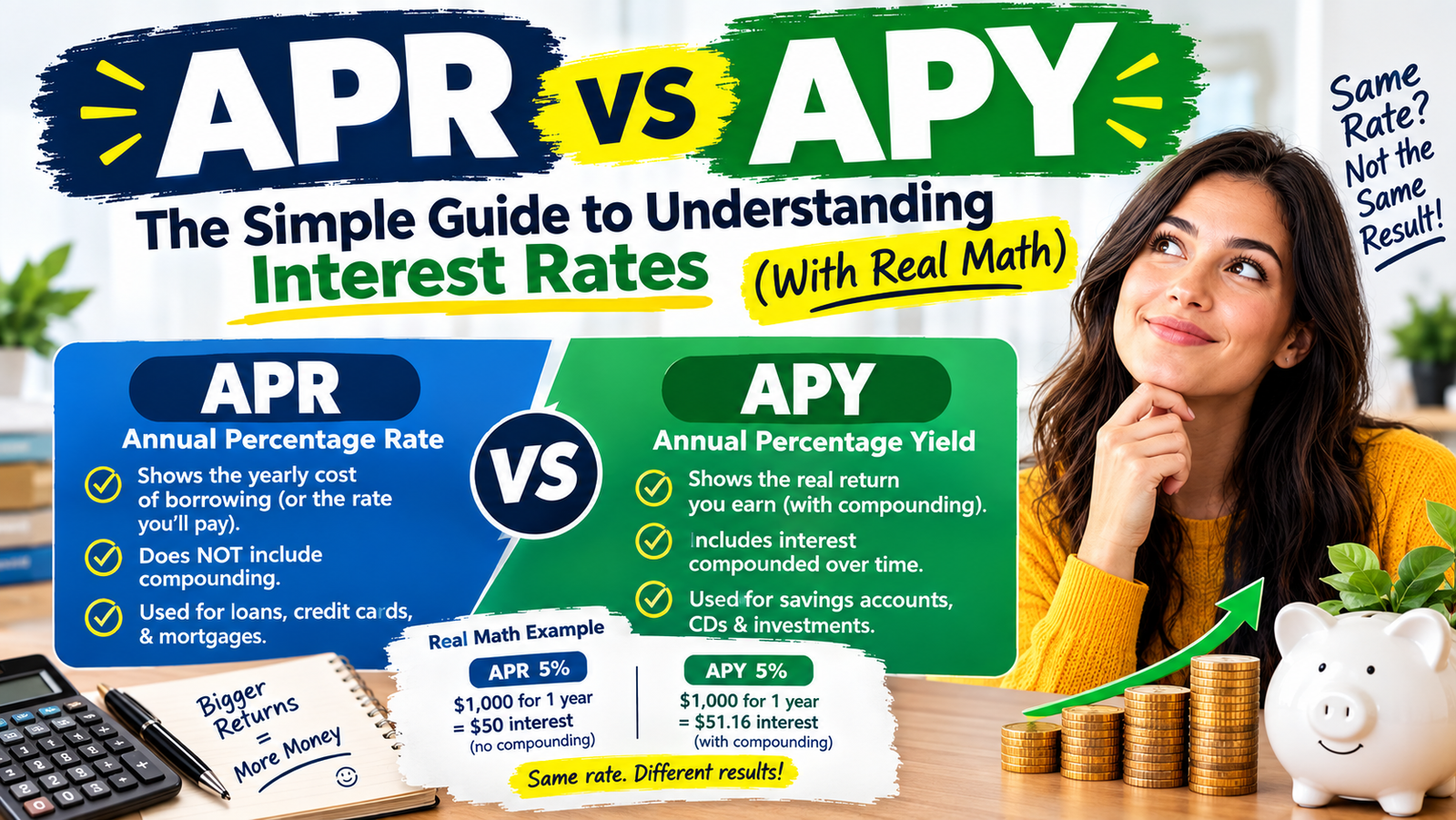
Here’s a number that trips up more people than it should: a savings account advertising “5% APY” and one advertising “5% interest rate” are not the same account. One will actually pay you more. If you’ve ever squinted at a bank’s fine print wondering why there are two different percentages for what seems like the same thing, you’re not alone — and the confusion between APR vs APY costs everyday savers and borrowers real money every year. This guide breaks down exactly what each term means, why the gap between them exists, and how to use that gap to your advantage whether you’re saving, borrowing, or comparing credit cards.
What Are APR and APY? The Real Difference
APR stands for Annual Percentage Rate. It’s the yearly cost of borrowing money, expressed as a percentage, and it typically does not account for compounding within the year. When you see an APR on a credit card, personal loan, or mortgage, you’re looking at the base rate lenders charge (sometimes with fees folded in, depending on the product).
APY stands for Annual Percentage Yield. It’s the yearly rate of return you actually earn (or, less commonly, pay) once compounding is factored in. APY answers the question: “If I leave my money in this account for exactly one year, what will I actually end up with?”
The short version: APR ignores compounding, APY includes it. That single distinction is why a 5% APR loan and a 5% APY savings account behave differently than their headline numbers suggest.
APR: The Cost of Borrowing, Simplified
APR shows up most often on:
- Credit cards
- Personal loans
- Auto loans
- Mortgages
In the U.S., the Truth in Lending Act requires lenders to disclose APR so consumers can compare loan costs on an apples-to-apples basis. That’s genuinely useful — but APR still has a blind spot: most credit card interest actually compounds daily, not annually, which means the effective cost of carrying a balance is higher than the advertised APR alone implies.
APY: The Power of Compounding, Simplified
APY shows up most often on:
- Savings accounts
- Certificates of deposit (CDs)
- Money market accounts
Banks are required (under the Truth in Savings Act) to disclose APY specifically because it reflects compounding — daily, monthly, or quarterly — which makes it the more honest number for savers trying to compare where to park their cash.
[Internal Link: “related article about how compound interest works”]
Why the Difference Actually Matters to Your Money
This isn’t just semantics. The gap between APR and APY grows with two things: the underlying interest rate, and how frequently interest compounds.
The Compounding Effect Over Time
Take a nominal rate of 6% compounded monthly. Run that through the math, and the effective annual yield comes out to roughly 6.17% — not 6%. On a $10,000 balance over a year, that’s about $17 you’d miss if you assumed the nominal rate was the whole story. It sounds small at that scale, but stretch it across a 30-year mortgage or a credit card balance carried for years, and the gap compounds into real money — pun intended.
Here’s the general pattern worth internalizing:
- Higher compounding frequency = bigger gap between APR and APY. Daily compounding pushes the effective rate further above the nominal rate than annual compounding does.
- Higher interest rates = bigger gap. The difference between APR and APY is barely noticeable at 1%, but becomes significant at 20%+ (which is exactly the range many credit cards live in).
Why Lenders and Banks Advertise Different Numbers
This is where it gets a little cynical, but it’s worth saying plainly: institutions tend to advertise whichever number looks better for them.
- A bank offering a savings account will highlight APY, because compounding makes the number look bigger and more attractive.
- A lender offering a loan will sometimes lead with the nominal rate or APR rather than the true effective rate, because compounding would make the cost look worse.
Neither is illegal or even necessarily deceptive — it’s just how the numbers work in each direction. Knowing which one you’re looking at is the whole game.
How to Calculate APR and APY: Step-by-Step
You don’t need to be a spreadsheet wizard to do this math. Here’s the breakdown.
The APY Formula, Broken Down
The standard formula is:
APY = (1 + r/n)^n − 1
Where:
- r = the nominal annual interest rate (as a decimal)
- n = the number of compounding periods per year (12 for monthly, 365 for daily, etc.)
Worked example: A 5% nominal rate compounded monthly.
- r = 0.05, n = 12
- (1 + 0.05/12)^12 − 1 = 0.05116, or about 5.12% APY
Worked example, daily compounding: Same 5% nominal rate, compounded daily.
- r = 0.05, n = 365
- (1 + 0.05/365)^365 − 1 ≈ 0.05127, or about 5.13% APY
Notice daily compounding barely edges out monthly here — the frequency matters less than most people assume once you’re compounding more than monthly. The biggest jump is going from annual compounding (no gap at all) to monthly.
Converting APR to APY (and Back)
If you only have the APR and the compounding frequency, plug it into the formula above as r. If you’re going the other direction — you know the APY and want the nominal rate — you rearrange it:
r = n × [(1 + APY)^(1/n) − 1]
Most people will never do this by hand regularly; a compound interest calculator or your bank’s disclosure statement (required by law) will do it for you. But understanding the mechanics means you can sanity-check any number a bank or lender shows you.
[Internal Link: “related article about compound interest calculators”]
Common Mistakes People Make With APR and APY
Assuming They’re Interchangeable
The single most common mistake: treating “5% APR” and “5% APY” as the same offer. They’re not, and the direction of the error matters. If you’re comparing loans, assuming APR = APY understates the true cost. If you’re comparing savings accounts, assuming APY = APR understates your true return (in your favor, but it still means you’re not doing the math right).
Ignoring Compounding Frequency
Two accounts can both advertise “APY” and still differ if their compounding schedules differ before the APY was calculated — but since APY already bakes in compounding, this is less of a trap than comparing raw nominal rates. The real trap is comparing a nominal rate on one product to the APY on another. That’s not an apples-to-apples comparison, and it’s an easy way to be misled by marketing copy that cherry-picks whichever number looks best.
Overlooking Fees Hidden in APR
On loans, APR sometimes includes origination fees and other costs rolled into the annualized figure — which is exactly why the law requires it for loan comparisons. Skipping past this and only looking at the “interest rate” line can hide the true cost of borrowing.
Expert Tips for Using APR and APY to Your Advantage
For Savers
- Always compare APY, not nominal rate, when shopping for savings accounts or CDs — it’s the only number that reflects what you’ll actually earn.
- Check compounding frequency when two accounts show similar nominal rates but different APYs; daily or continuous compounding usually wins over monthly.
- Watch for promotional APY traps — some accounts advertise a high APY that only applies for the first 3–6 months, then drops to a much lower ongoing rate.
- Reinvest interest whenever possible in accounts where compounding is automatic, since manually withdrawing interest resets your compounding base.
For Borrowers
- Compare APR across lenders for the same loan type — it’s the standardized, legally required figure specifically designed for this comparison.
- Understand your card’s compounding schedule. Most credit cards compound daily, so the effective cost of carrying a balance is meaningfully higher than the sticker APR.
- Pay attention to what’s baked into APR — for mortgages specifically, ask whether points and fees are included, since APR calculation methods can vary by loan type.
Comparison Table: Where APR vs. APY Shows Up
| Feature | Credit Cards | Personal Loans | Savings Accounts | CDs |
|---|---|---|---|---|
| Rate typically shown | APR | APR | APY | APY |
| Compounding | Usually daily | Rarely compounds (simple interest common) | Daily or monthly | Daily or monthly |
| Legally required disclosure | APR (Truth in Lending Act) | APR (Truth in Lending Act) | APY (Truth in Savings Act) | APY (Truth in Savings Act) |
| Who benefits from the higher number | The lender | The lender | You, the saver | You, the saver |
| Best practice when comparing | Compare APR across offers | Compare APR across offers | Compare APY across offers | Compare APY across offers |
Who Should Care About APR vs. APY (and Who Really Doesn’t)
You should care if you’re actively comparing savings products, evaluating loan offers, carrying a credit card balance, or trying to understand why two “similar” financial products yield different real-world outcomes. Anyone making a decision involving more than a few hundred dollars over more than a few months benefits from understanding this distinction.
You probably don’t need to obsess over it if you’re comparing two loans with identical terms and only a hundredth-of-a-percent difference in advertised rate, or if you’re choosing between checking accounts where interest is negligible either way. In those cases, other factors (fees, customer service, account minimums) matter more than chasing the last basis point.
Conclusion
The APR vs. APY distinction comes down to one idea: APR is the sticker price, APY is what compounding actually does to that price over a year. For borrowers, that means always comparing APR across offers — it’s the standardized, legally mandated number built for exactly that purpose. For savers, it means ignoring nominal rates entirely and shopping by APY, since that’s the figure that reflects what actually lands in your account. Once you internalize that one rule — APR for borrowing comparisons, APY for saving comparisons — the rest of the math takes care of itself. Next time you see a bank ad with a big bold percentage, you’ll know exactly which question to ask: is that APR, or is that APY?
3. FAQ Section
Q1: Is APY always higher than APR?
For the same underlying nominal rate on the same account, yes — APY will be equal to or higher than the nominal rate, because it includes compounding. But you can’t directly compare an APR on one product to an APY on a different product and assume the APY one is “better,” since they’re describing different mechanics (borrowing cost vs. compounded yield).
Q2: Why is my savings account’s APY higher than the interest rate I was quoted?
Because the quoted rate was likely the nominal annual rate, and APY reflects that same rate after compounding is applied. If your bank compounds interest daily or monthly rather than just once a year, the effective yield — your APY — ends up higher than the nominal figure.
Q3: Does APR include compounding at all?
Generally, no. APR is typically calculated as a simple annualized rate and does not factor in intra-year compounding, which is exactly why credit card issuers can advertise a lower-sounding APR while interest actually compounds daily behind the scenes.
Q4: How do I convert APR to APY?
Use the formula APY = (1 + r/n)^n − 1, where r is the nominal rate as a decimal and n is the number of compounding periods per year. In my experience, it’s easiest to just plug numbers into an online compound interest calculator rather than doing this by hand every time — the formula matters more for understanding why the numbers differ than for daily use.
Q5: Which number should I use to compare credit cards?
APR. It’s the number required by law for exactly this purpose, and it standardizes fees and costs into one annualized figure so you can compare offers side by side.
Q6: Which number should I use to compare savings accounts or CDs?
APY, every time. Banks are required to disclose APY specifically because it reflects real compounding, and it’s the number that tells you what you’ll actually earn over a year.
Q7: Can APR and APY ever be the same number?
Yes — if interest compounds only once per year (annual compounding), APR and APY are mathematically identical. The gap only appears once compounding happens more than once a year.
Q8: Why do credit cards compound daily instead of monthly?
Honestly, it benefits the issuer. Daily compounding on a carried balance means interest accrues on interest more frequently, which raises the effective cost to the cardholder compared to less frequent compounding — one more reason paying off balances in full each month matters so much.
Q9: Does a higher APY always mean a better savings account?
Not necessarily on its own. Watch for introductory APY offers that drop after a few months, minimum balance requirements that disqualify you from the advertised rate, or account fees that eat into your real return. APY is the right comparison metric, but it’s not the only variable.
Q10: Is APY the same as “interest rate” on a mortgage?
No — mortgages typically use APR, not APY, and mortgage APR can include additional costs like points and origination fees, not just the interest rate itself. That’s part of why mortgage APR is usually slightly higher than the quoted “interest rate” on the loan.