
Here’s a stat that should make you open your credit report tonight. A congressionally mandated FTC study found that one in five consumers had an error on at least one of their three credit reports, and five percent had errors that could lead them to pay more for things like auto loans and insurance. Yet most people only ever look at their score, one number in an app, and never open the record that produces it. ftc
That gap is why the credit report vs. credit score question matters. The two sound like synonyms, but they aren’t. One is the raw record of your borrowing life. The other is a summary someone calculates from that record.
Mix them up and you’ll chase the wrong fixes, trust the wrong number, or miss an error that quietly costs you thousands. This guide breaks down what each one is, how they connect, why your scores differ from app to app, and a simple method for using both to your advantage.
Credit Report vs. Credit Score: The Core Difference
Here’s the short version, the one worth memorizing:
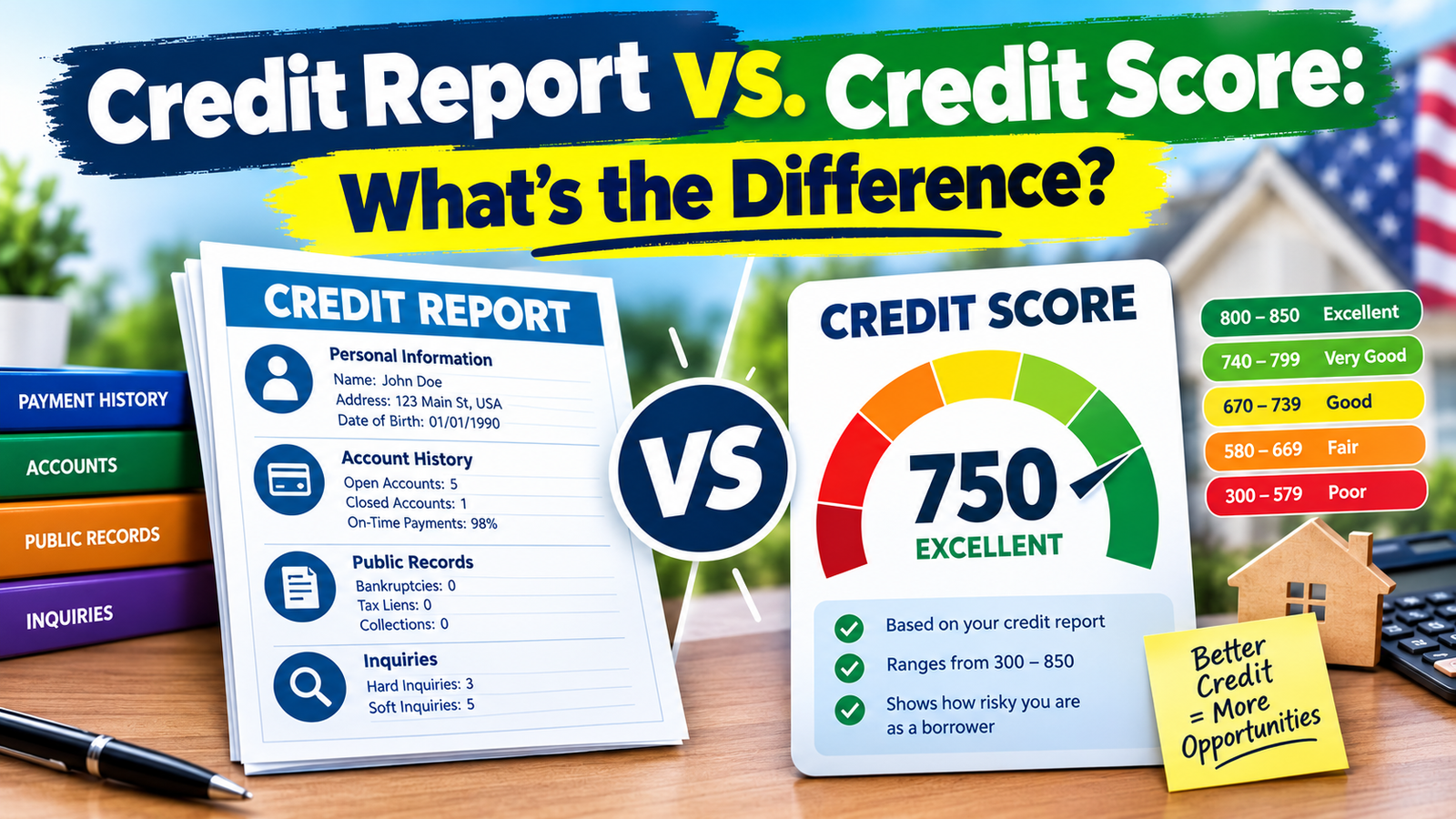
A credit report is a detailed record of your credit history. A credit score is a three-digit number calculated from that record. The report is the evidence; the score is the verdict.
| Credit report | Credit score | |
|---|---|---|
| What it is | A detailed file of your accounts and payment history | A number that summarizes your risk as a borrower |
| Format | Multi-page document, organized by section | Three digits (commonly 300–850) |
| What’s in it | Personal info, accounts, balances, payment history, collections, inquiries | No raw data; only the calculated result |
| Who creates it | Credit bureaus (Equifax, Experian, TransUnion) compile it | Scoring companies (FICO, VantageScore) calculate it |
| How many you have | One per bureau, so three main reports | Many, depending on model and bureau |
| Best used for | Spotting errors, fraud, and unfamiliar accounts | Quick benchmarking of your credit standing |
| Changes when | Lenders report new activity | The underlying report changes (or the model changes) |
Notice the direction of flow. Data goes from lenders to bureaus to your report. A scoring model then reads the report and produces the score. So the report always comes first. If the report is wrong, the score will be wrong too.
What is a credit report?
Your credit report is a file of your credit history, maintained by the three nationwide credit bureaus: Equifax, Experian, and TransUnion. Lenders, card issuers, and collection agencies send them information about you, and the bureaus organize it into a report. Because not every lender reports to every bureau, your three reports can differ.
A typical report has four parts:
- Personal information: name, current and past addresses, date of birth, and a partial or full Social Security number. Nothing here affects your score, but it’s where mixed-file and identity errors often start.
- Accounts (tradelines): credit cards, mortgages, auto loans, student loans. Each shows the lender, when it opened, your credit limit or original loan amount, current balance, and month-by-month payment status.
- Collections and public records: accounts sent to collection agencies and certain court records such as bankruptcies.
- Inquiries: a list of who has looked at your file. Hard inquiries (from applications) show up for lenders to see. Soft inquiries (like checking your own report) are visible only to you.
Most negative items stay on a report for about seven years, and some bankruptcies can remain for up to ten. Hard inquiries generally stay for two years.
Just as important is what your report doesn’t contain. It has no income, no bank balances, and no score. That last point surprises people: your credit report does not show your credit score, so checking your score alongside your report takes separate steps. nasdaq
What is a credit score?
A credit score is a number that predicts how likely you are to repay debt on time. The two dominant families are FICO and VantageScore, and both typically run from 300 to 850. FICO’s commonly cited ranges look like this:
- 300–579: Poor
- 580–669: Fair
- 670–739: Good
- 740–799: Very good
- 800–850: Exceptional
Think of a score as a snapshot, not a stored file. There’s no single “official” number sitting in a vault. A score gets calculated on demand, from your report, using a specific model, at a specific moment. Change any of those three and the number can change.
Why this matters right now in 2026
The credit landscape has shifted in ways worth knowing. FICO’s fall 2026 report says the national average FICO Score held steady at 714, though lower-scoring and thin-file borrowers face the most pressure. Its spring report noted a record 48.1% of consumers with FICO Scores of 750 or higher, even as the average slipped 2 points, driven mainly by resumed student loan delinquency reporting and a modest rise in mortgage delinquencies. placerafico
That last detail is a real-world example of report-first thinking. When student loan delinquencies began appearing on reports again, scores moved because the underlying data changed. Anyone who only watched their score saw a mystery drop. Anyone who read their report saw the cause.
There’s also good news: the three credit bureaus have permanently extended a program letting you check your report at each bureau once a week for free. There’s no longer a good excuse for not looking. ftc
Why the Difference Matters: The Real Stakes
Who sees what
Different people look at different things, and knowing which is which helps you prepare.
- Lenders (mortgage, auto, cards): They typically use both. The score gives a fast screen; the report gives the details underwriters review. According to FICO, its scores are used by 90% of the top U.S. lenders. businesswire
- Landlords: Often pull a report or a tenant-screening summary that draws on it.
- Insurers: In most states, insurers use a credit-based insurance score derived from your report to help set premiums.
- Employers: With your permission, some employers can see a version of your credit report. They don’t get your score.
So the report is what a human reads, and the score is what a system ranks.
What errors actually cost
Let’s put money on it. Suppose a strong score helps you qualify for a 6.5% rate on a $350,000, 30-year mortgage, while a weaker one lands you at 7.5%. (These rates are purely hypothetical, to show scale.) Your monthly payment would be about $2,212 versus $2,447. That’s roughly $235 more a month, or about $84,000 over the life of the loan.
Now connect that to the FTC’s findings above. Five percent of consumers had errors that could lead to paying more for products like auto loans and insurance. That’s the risk of not reading your report. To be fair, the credit industry’s trade group argued the study showed the proportion of reports with errors that could raise rates was small. And the study dates to 2013, so I treat it as directional rather than a precise current error rate. But even a small percentage of a very large population is a lot of people, and checking is free. ftcwpengine
Garbage in, garbage out
Here’s my honest opinion: obsessing over the score while ignoring the report is like checking your car’s speedometer but never looking under the hood. The score is a symptom. The report is the machinery.
A mistaken late payment, an account that isn’t yours, a balance that never got updated after you paid it off: those all live on the report. Fix them there, and the score fixes itself.
[AUTHOR: Add a two-sentence first-hand moment here, like a time you found an error on your own report or helped someone who did. It should be real.]
How They Work Together: A Step-by-Step Breakdown
I call the approach below the Report-First Method: audit the source data before you try to optimize the number. It follows the way the system actually works, so you fix problems where they start.
Step 1: Understand the pipeline
The flow is simple:
- You borrow (open a card, take a loan).
- Your lender reports activity to one or more bureaus, usually monthly.
- The bureaus update your credit report.
- A scoring model reads the report and calculates a score.
- A lender, landlord, or insurer looks at the score and/or the report and makes a decision.
Every arrow is a place where something can go wrong: a lender reports late, a bureau mixes files, a model weighs things differently. Once you see the pipeline, “why did my score change?” becomes answerable.
Step 2: Know how the score is calculated
FICO publishes the general weights of the factors it considers:
- Payment history (35%): Do you pay on time? This is the biggest lever.
- Amounts owed (30%): Mainly your credit utilization, meaning how much of your available revolving credit you’re using. Lower is better, and staying under about 30% is the common rule of thumb, with single digits often best.
- Length of credit history (15%): The age of your accounts, oldest, newest, and average.
- New credit (10%): Recent applications and newly opened accounts.
- Credit mix (10%): The variety of credit types you manage.
VantageScore uses a different formula with different emphasis. It also scores some people with thinner files, and newer models from both companies (like VantageScore 4.0 and FICO’s trended versions) look at how your balances have moved over time, not just where they are today.
Step 3: Understand why you have many scores
This is the source of most confusion. Multiple things differ:
- Different bureaus: Your Equifax, Experian, and TransUnion reports may not contain identical data, so the same model can give three different numbers.
- Different models: FICO and VantageScore differ, and each has multiple versions (FICO 8, FICO 9, FICO 10, and so on).
- Industry-specific scores: Auto lenders and card issuers often use specialized FICO versions tuned for their products.
- Different purposes: Mortgage lending has traditionally leaned on older FICO versions, and the rules there have been shifting, so ask your lender which model they’ll pull.
According to Financer’s roundup of current data, the average U.S. score is about 714 on FICO and 701 on VantageScore 4.0. Notice that the “average” itself depends on which model you ask. financer
So if your free app says 730 and your lender says 705, nobody’s necessarily lying. You’re likely looking at different models, different bureaus, or different days.
Step 4: Pull all three of your reports
Go to AnnualCreditReport.com, the site the credit bureaus point people to for free reports. The FTC warns that other sites may charge you or be fraudulent sites set up to steal your personal information. By law, you’re entitled to one free report every twelve months from each bureau, and the weekly access described earlier is now permanent. ftc
Pull all three. Errors are often bureau-specific, so checking just one can leave a mistake hiding on another.
[Internal Link: “how to get your free credit reports step by step”]
Step 5: Audit the report like an editor
Read it slowly, section by section. Here’s a checklist:
- Personal info: wrong addresses, names you don’t recognize, accounts tied to someone else’s Social Security number
- Accounts you don’t recognize: possible fraud or a mixed file
- Wrong statuses: an account marked open that you closed, or “late” when you paid on time
- Wrong balances or limits: a stale balance can inflate your utilization
- Duplicate collection accounts: the same debt listed by the original creditor and a collector
- Old negatives past their reporting window: items that should have aged off
- Inquiries you didn’t authorize: possible sign of fraud
Step 6: Dispute what’s wrong
Under the Fair Credit Reporting Act, you can dispute inaccurate information with the bureau and with the company that furnished it. Do it in writing or through the bureau’s dispute portal, attach documentation (statements, payoff letters, police or identity-theft reports where relevant), and keep copies of everything. Bureaus generally have about 30 days to investigate.
If the item is verified as accurate, the dispute won’t remove it, and I’d steer clear of anyone promising to erase legitimate negatives. If the bureau sides against you and you have proof, you can escalate with a complaint to the Consumer Financial Protection Bureau.
[Internal Link: “how to dispute a credit report error (with sample letter)”]
Step 7: Then optimize the score, and monitor
Only after the report is clean does it make sense to work on score drivers: pay on time, keep utilization low, avoid unnecessary new applications, and keep your oldest accounts open. Then check your report periodically (weekly access is free, though most people need it far less often) and track your score as a trend, not a daily scoreboard.
Common Mistakes People Make (and How to Avoid Them)
Honestly, most people get this wrong in the same handful of ways.
1. Treating the two as the same thing.
“I checked my credit” could mean either. Be specific with yourself: did you review the report (the evidence) or glance at the score (the summary)? You need both, for different jobs.
2. Only watching the score.
A score can look fine while a fraudulent account or wrong status sits in the report, waiting to bite you at your next loan application. Score-watching alone is incomplete.
3. Using look-alike sites.
Search for “free credit report” and you’ll find plenty of sites that aren’t the official source, some of which enroll you in paid subscriptions or harvest your data. Use AnnualCreditReport.com directly.
4. Assuming one score is “the” score.
There isn’t one. Chasing a single number from a single app can mislead you, especially before a mortgage or auto loan.
5. Believing that checking your own report hurts your score.
It doesn’t. Checking your own report or score is a soft inquiry, which doesn’t affect your score. Hard inquiries come from applying for credit.
6. Closing old cards to “tidy up.”
Closing an old card can shorten your history and reduce your available credit, which raises your utilization. Unless there’s an annual fee you can’t justify, I’d rather keep it open with a small recurring charge.
7. Paying a “credit repair” company to fix accurate information.
You can dispute errors yourself for free. Anyone guaranteeing they’ll remove accurate negatives is selling something that legitimately can’t be promised.
[AUTHOR: If you’ve made one of these mistakes yourself, say which and what it cost you. Readers trust the honest version.]
Expert Tips & Advanced Strategies
If you’ve read a few beginner explainers, this is the material they skip.
1. Rotate your checks.
With free weekly reports available, you can space out a look at each bureau across the year and catch problems sooner than a single annual check. A quick scan, not a deep audit, is enough for most weeks.
2. Know your statement date, not just your due date.
Card issuers generally report your balance to the bureaus around your statement closing date, not your due date. If you pay before the statement closes, a lower balance gets reported, which can lower your utilization at the moment it’s measured.
3. Freeze your credit if you’re not applying.
A credit freeze is free by federal law. It blocks new lenders from opening accounts in your name, doesn’t affect your score, and doesn’t touch your existing accounts. You can lift it temporarily when you apply. For most people, it’s the strongest anti-fraud move available.
4. Rate-shop inside the window.
Scoring models typically treat multiple mortgage, auto, or student-loan inquiries within a short period as a single inquiry for shopping purposes. The window varies by model, commonly somewhere between 14 and 45 days. Do your comparison shopping in a tight burst.
5. Ask which score your lender will use.
Before a big application, ask which model and which bureau(s) they pull. It tells you which of your numbers actually matters and avoids nasty surprises.
6. Try a goodwill request for a one-time slip.
If you have a long history of on-time payments and a single late payment, writing to the lender asking for a goodwill adjustment costs nothing. It doesn’t always work, but I’ve seen it be worth the stamp.
7. Consider tools that add positive data, with realistic expectations.
Some services can add on-time rent or utility payments to your file. They may affect only certain bureaus or models, so treat them as a possible boost, not a guarantee, and check that a lender will actually count them.
Real Scenarios: What This Looks Like in Practice
These are composite scenarios built from common patterns, with rounded numbers for clarity. They aren’t real clients or guaranteed outcomes.
Scenario 1: The mystery score drop
Priya notices her score fell from the low 740s to the low 680s in one month, right before she planned to apply for a car loan. She doesn’t guess. She pulls all three reports and finds a collection account on one bureau, from a debt that isn’t hers, likely a mixed file with someone of a similar name.
She files a dispute with documentation, and the bureau removes the item after its investigation, in roughly five weeks. Her score rebounds to near its prior level. The score told her something was wrong; the report told her what.
Scenario 2: Three apps, three numbers
Marcus sees 731 in a free app, 715 on a FICO score from his card issuer, and 698 when his mortgage lender runs his file. He assumes something is broken. It isn’t. Different models, different bureaus, and older scoring versions on the mortgage side explain the spread.
Because he asked early, he knew the lender’s number was the one that mattered. He spent his prep time on the factors that drive that score, chiefly paying his card down before the statement date, and closed at a rate he was happy with.
Scenario 3: The thin file
Jordan, early in his career, has one card and a report showing eight months of history. He has a score, but a modest one, because there isn’t much data. He pays the card in full, keeps utilization in single digits at statement close, and adds an installment or rent-reporting source where it makes sense.
A year later his report shows a longer, cleaner history and his score has moved into the high 600s or low 700s. There’s no trick here, just time and consistency showing up in the data.
[AUTHOR: If you have a real story with real numbers, swap it in here.]
Who should follow this approach, and who shouldn’t
This approach is a great fit if:
- You’ve never actually read your credit report
- You’re planning a mortgage, auto loan, or big credit application in the next 6–12 months
- Your score changed and you don’t know why
- You’ve been denied credit or suspect identity theft
Adjust it, or get personal help, if:
- You’re dealing with identity theft. Beyond disputes, you may need fraud alerts, a freeze, and a report to the FTC. Start at IdentityTheft.gov.
- You’re in serious debt or facing collections. A nonprofit credit counselor can help you build a plan; be wary of for-profit “credit repair” promises.
- You’re compulsively checking your score. Daily fluctuations are normal noise. Look at the trend and the report, not the daily number.
- You don’t plan to borrow anytime soon. You can relax on frequency, but an annual report check is still smart, especially to catch fraud.
I’m not a lawyer or a licensed financial advisor, and nothing here is personalized advice. If your situation involves legal disputes or complex debt, a qualified professional is worth consulting.
Conclusion: Read the Report, Then Watch the Score
Here’s what I’d want you to walk away with. The credit report vs. credit score distinction isn’t trivia. The report is the record, the score is the summary, and the summary is only as trustworthy as the record behind it.
So use the Report-First Method: pull all three reports, audit them, dispute real errors, and only then tune the habits that drive your score. Keep your credit frozen when you’re not applying, and ask lenders which score they actually use.
Do one thing tonight. Go to AnnualCreditReport.com and pull a report from one bureau. Ten minutes, no cost, no score impact. Scan it for accounts you don’t recognize.
Then tell me in the comments: what surprised you most? If you found something odd, I’d genuinely like to hear how it turned out.
4. Comparison Table: Where Should You Check Your Credit?
| Option | What you get | Score model | Typical cost | Best for | Watch out for |
|---|---|---|---|---|---|
| AnnualCreditReport.com | Full credit reports from Equifax, Experian, and TransUnion | None (reports only) | Free | Auditing for errors and fraud | Doesn’t show your score; use only the official site |
| Card issuer or bank dashboard | A score, often with a few key factors | Varies (often a FICO version) | Usually free | Quick, regular score checks | Model and bureau vary by issuer, so it may differ from your lender’s |
| Free credit-monitoring apps | A score plus alerts, often from one or two bureaus | Often VantageScore | Free (usually ad- or offer-supported) | Trend tracking and change alerts | Not necessarily the score a lender will use |
| Paid FICO / bureau subscriptions | Multiple scores, reports, and monitoring extras | FICO and others | Roughly $10–$40/month | People wanting multiple FICO versions or added protection | Costs add up; free options cover most needs |
| Your lender’s pull | The exact score and report used for your application | Whatever the lender uses | Part of applying (creates a hard inquiry) | The number that truly counts for that loan | You only see it during the application, so ask ahead |
Paid versions are typically bundled with extras: paid reports run about $10 to $40 a month and often include identity theft insurance, fraud alerts, or dark web monitoring. Useful for some people, unnecessary for many. necn
My take: Use AnnualCreditReport.com for the report and your card issuer’s free score for the number. Skip paid subscriptions unless you specifically want the extras.
[Internal Link: “best free credit monitoring tools compared”]
5. FAQ Section
Q: What is the main difference between a credit report and a credit score?
A: A credit report is a detailed record of your credit history, including accounts, balances, payment history, collections, and inquiries. A credit score is a three-digit number calculated from that report to estimate how risky you are as a borrower. The report is the raw data, and the score is the summary. Lenders may look at both, but errors live in the report, so that’s where fixes start.
Q: Does checking my credit report hurt my credit score?
A: No. Checking your own credit report or score is a soft inquiry, which doesn’t affect your score. Hard inquiries happen when you apply for credit, like a new card or loan, and can have a small, temporary effect. My advice: never let fear of a “score hit” stop you from reviewing your own file. Looking is free, safe, and one of the smartest habits you can build.
Q: How often should I check my credit report?
A: At minimum, review all three reports once a year, and before any major application like a mortgage or auto loan. Because free weekly access at each bureau is now permanent, you can check more often if you want. In my opinion, a quick quarterly look, rotating bureaus, catches most problems early without turning credit into a hobby. ftc
Q: Where can I get my credit report for free?
A: Use AnnualCreditReport.com, the site the bureaus point consumers to for free reports from Equifax, Experian, and TransUnion. The FTC cautions that other sites may charge you or be fraudulent sites set up to steal your personal information. By law you’re entitled to at least one free report per bureau every twelve months, and weekly access is now permanent. The reports don’t include your score, so check that separately. ftc
Q: Why are my credit scores different from each bureau and app?
A: Scores vary because the underlying data can differ by bureau, and because there are multiple scoring models and versions (FICO, VantageScore, and industry-specific variants). An app might show a VantageScore from one bureau while your lender pulls an older FICO from another. Timing matters too, since scores are calculated on demand. I wouldn’t fret over gaps of a few points, but ask your lender which score they’ll use.
Q: What is a good credit score?
A: On FICO’s common scale, 670–739 is generally considered good, 740–799 very good, and 800 and above exceptional. For context, the national average FICO Score is about 714. What counts as “good enough” depends on the loan, since the best rates typically go to higher tiers. Focus on what you can control: pay on time, keep utilization low, and keep old accounts open. placera
Q: Does a credit report show your credit score?
A: Generally, no. Your credit report does not show your credit score, so you’ll need separate steps to view your score alongside your report. You can get scores through many card issuers, banks, and monitoring services, but remember the score you see may not match the one a lender uses. My habit: read the report for accuracy and treat the score as a convenient summary. nasdaq
Q: How long do negative items stay on a credit report?
A: Most negative items, like late payments and collections, generally stay for about seven years from the date of the first missed payment. Some bankruptcies can remain up to ten years, and hard inquiries typically stay for two years. Their impact usually fades as they age and as you add positive history. Time plus consistent on-time payments is the most reliable “fix” for legitimate negatives.
Q: What should I do if there’s an error on my credit report?
A: Dispute it with the credit bureau and the company that reported it, in writing or through the bureau’s portal, and attach documentation like statements or payoff letters. Keep copies of everything. Bureaus generally have about 30 days to investigate. If it isn’t resolved and you have proof, you can escalate with a complaint to the CFPB. My advice: dispute directly and for free. You don’t need to pay a “credit repair” company to do it.
Q: Which matters more, my credit report or my credit score?
A: They matter for different reasons, and they depend on each other. The score is what lenders often see first, but it’s built from the report, so an error in the report can silently drag the score down. My honest take: read the report first, then watch the score. If the report is clean and accurate, the score usually takes care of itself.