
Let me start with the number that explains why so many debt repayment plans fail: 19.56%. That’s the average credit card interest rate right now, according to Bankrate. On a $6,000 balance, roughly $98 of your first month’s payment goes straight to interest before a single dollar shrinks what you owe.
And plenty of Americans are carrying balances like that. The New York Fed reports that household debt hit $18.8 trillion in the second quarter of 2026, including about $1.26 trillion on credit cards.
Here’s my honest take: most people don’t stay in debt because of bad math. They stay because their plan doesn’t survive real life, like a surprise car repair, a slow month, or a boring Tuesday when motivation vanishes. A good debt repayment plan isn’t the mathematically perfect one. It’s the one you’re still following in month nine.
That’s what this guide is for. You’ll get a five-move debt repayment plan built around behavior, real dollar examples, a side-by-side of the main strategies, and ways to keep going when it gets hard.
What Is a Debt Repayment Plan? The Real Definition
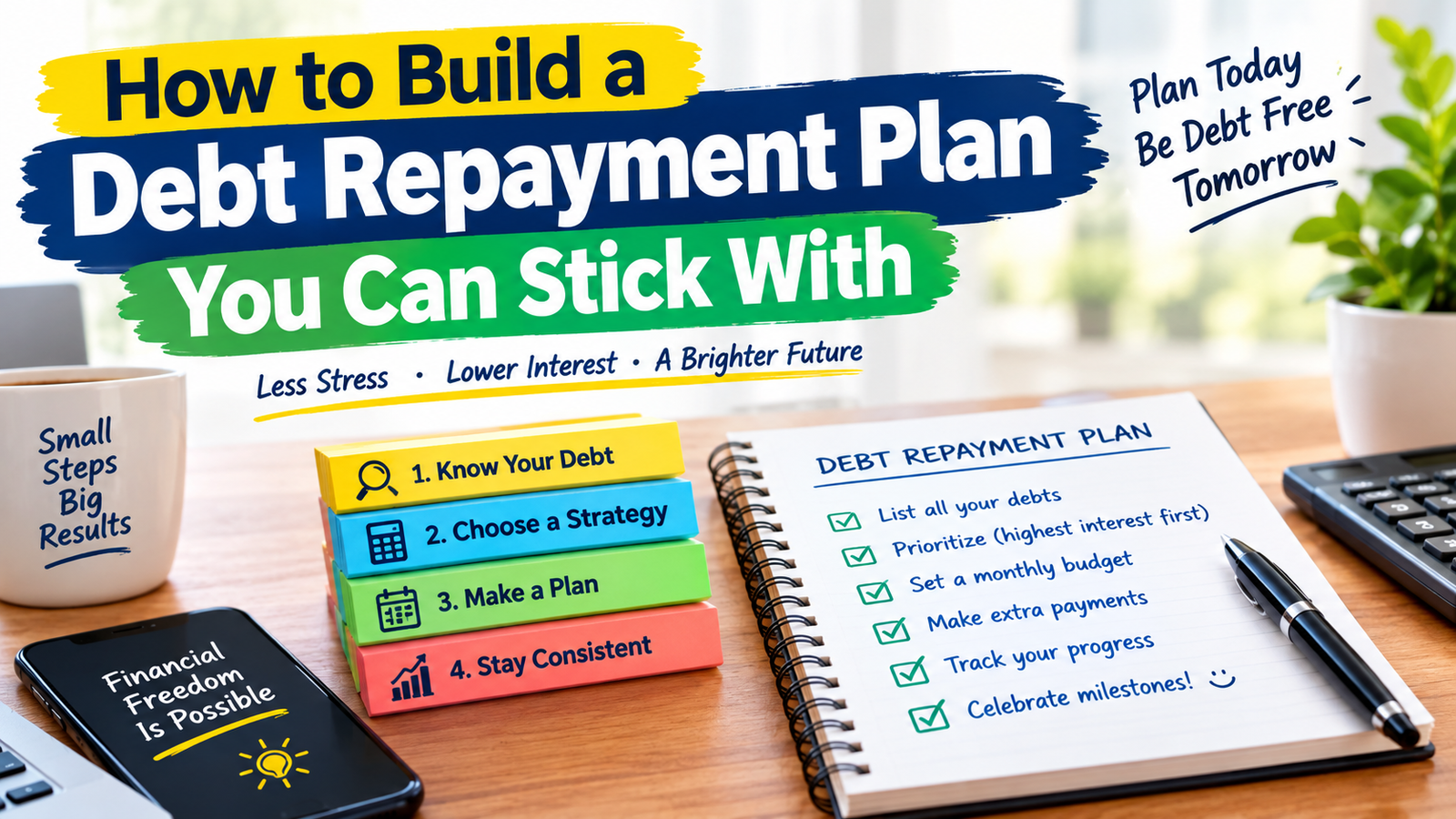
A debt repayment plan is a written, dated strategy that tells every dollar you earmark for debt exactly where to go: which debts, in what order, how much per month, funded from where, and finished by when.
Notice how specific that is. “I’ll try to pay more toward my cards” is a hope. “Every payday, $300 goes to Card A while the minimums are autopaid on everything else, and I’m debt-free by March 2029” is a plan.
What a real debt repayment plan includes
Every plan that holds up has five parts:
- An inventory: every debt, with balance, interest rate (APR), minimum payment, and due date.
- A monthly number: the total amount you’ll put toward debt each month, including minimums.
- A target order: which debt gets the extra dollars first, and why.
- Automation: payments that happen without you deciding to make them.
- A review rhythm: a scheduled check-in, milestones, and a plan for bad months.
Most online advice covers only the third part (snowball vs. avalanche) and ignores the other four. That’s backwards. The order matters far less than the rest.
Why most plans fail (it isn’t math)
In my opinion, plans die for three predictable reasons:
- They’re built for a perfect month. One surprise expense and the whole thing collapses.
- They depend on willpower. Manual payments mean a decision every month, and decisions get skipped.
- They’re invisible. If you can’t see progress, you can’t feel it, and if you can’t feel it, you quit.
Everything in the plan below is designed to fix those three problems.
Why this matters right now in 2026
The pressure is real but not out of control. The New York Fed says 4.7% of outstanding household debt was in some stage of delinquency in Q2 2026, and that delinquency rates across most products have held steady over the past two years. Meanwhile, Bankrate’s February 2026 survey found 29% of Americans have more credit card debt than emergency savings. Average card rates have eased slightly from their August 2024 peak of 20.79%, but they’re still just under 20%. That’s expensive money to owe.
Why a Debt Repayment Plan Matters: The Real Stakes
The numbers
Here’s the landscape, from the New York Fed’s Q2 2026 data:
- Total household debt: $18.8 trillion
- Credit card debt: about $1.26 trillion (up $54 billion from a year earlier)
- Auto debt: about $1.71 trillion
- Student debt: about $1.65 trillion
Behind those aggregates are households making the same trade-off every month: minimums now, or a plan.
The minimum-payment trap
This is where a plan pays for itself. Take $10,000 on a card at the current average rate of 19.56%, with a fixed monthly payment and no new charges:
| Monthly payment | Time to pay off | Total interest |
|---|---|---|
| $200 | about 105 months (8.75 years) | about $10,870 |
| $300 | about 49 months (just over 4 years) | about $4,540 |
| $500 | about 25 months | about $2,200 |
Look at what happens between $200 and $300. Raising the payment by $100 cuts the timeline by more than half and saves over $6,000 in interest. Small increases in your monthly number have outsized effects because interest compounds against you the whole time.
Same story on a smaller balance. A $6,000 balance at 19.56% costs about $98 in interest the first month. Pay $150 a month and you’re looking at roughly 66 months and about $3,790 in interest. Pay $300 and it’s about 25 months and about $1,320.
The mental cost
I’ll say something the spreadsheets don’t: debt is exhausting. It creates background stress, avoidance (people stop opening statements), and decision fatigue. A plan converts a vague dread into a defined project with an end date. That shift alone is worth a lot, and it’s a big reason the psychology in the next section matters.
[AUTHOR: Add a short, honest paragraph about what carrying debt felt like for you or someone close to you. Specifics build trust.]
How to Build a Debt Repayment Plan You’ll Stick With
I call this the Stick-With-It Plan. It has five moves, and each one is designed to address a specific way plans break down.
Move 1: Get the full picture (the inventory)
Before you choose a strategy, you need the truth. Gather every debt and write it down: creditor, balance, APR, minimum payment, due date, and whether it’s secured (car, home) or unsecured (cards, personal loans).
Where to find everything: statements, lender apps, and your credit reports. Pulling your reports catches forgotten accounts and collections. [Internal Link: “credit report vs. credit score: what’s the difference?”]
Here’s the example household I’ll use throughout, with hypothetical numbers:
| Debt | Balance | APR | Minimum |
|---|---|---|---|
| Store card | $900 | 17.99% | $35 |
| Card A | $3,400 | 27.99% | $95 |
| Card B | $6,200 | 21.99% | $155 |
| Personal loan | $8,000 | 11.5% | $260 |
| Total | $18,500 | $545 |
Do this on paper or in a simple spreadsheet. It takes about 30 minutes. Many people avoid this step for months because it’s uncomfortable. Do it anyway. Nothing else works without it.
Triage tip: Not all debts are equal. Essentials (housing, utilities, food, transportation) come first. Then debts where you could lose something important (mortgage, car loan) or face serious consequences (taxes, child support). Credit cards and personal loans are important but lower on the “emergency” ladder. If money is truly short, protect the essentials first.
Move 2: Find your monthly number
Your monthly number is: income − essential living costs = what’s available for debt. That total includes your minimums plus any extra you can find.
In our example, the minimums are $545. Suppose the household finds $300 extra from three places:
- Trim: about $120 from subscriptions, dining out, and a cheaper phone plan
- Earn: about $100 from occasional side work or overtime
- Redirect: about $80 by holding steady on a bill they’d been planning to upgrade
That gives them $845 a month for debt.
A few rules for finding your extra:
- Be honest, not heroic. Cutting every fun expense to zero is a recipe for burnout. Leave a small “life” line.
- Build a starter buffer first. Before you go all-in, set aside $1,000–$2,000 so a flat tire doesn’t land on a card and undo your progress. [Internal Link: “emergency fund explained: how much should you save?”]
- Feed the plan with windfalls. Tax refunds, bonuses, and cash gifts are perfect one-time boosts.
Move 3: Choose your order (snowball, avalanche, or hybrid)
This is the part everyone argues about, so let me give you the actual data.
The avalanche method pays extra toward the highest-APR debt first. It’s mathematically optimal: it costs the least interest, and it’s the approach the U.S. government has recommended.
The snowball method pays extra toward the smallest balance first, regardless of rate. The logic is psychological: quick wins keep you motivated.
Is the psychology real? A Northwestern Kellogg study by David Gal and Blakeley McShane looked at how 6,000 people eliminated credit card debt. They found that closing accounts, independent of the balances involved, predicted eventual success in getting fully debt-free. That’s suggestive support for the snowball. In fairness, other researchers have noted the study can’t fully control for who chooses which method, so it’s evidence to take seriously rather than proof.
Now let’s test both on our example, using the $845 monthly number (fixed APRs, no new charges):
| Snowball | Avalanche | |
|---|---|---|
| Payoff order | Store card → Card A → Card B → Loan | Card A → Card B → Store card → Loan |
| First debt eliminated | Month 3 | Month 10 |
| Debt-free in | 27 months | 27 months |
| Total interest | about $3,870 | about $3,770 |
Same finish line. The avalanche saves about $105. The snowball delivers a win in month 3 instead of month 10.
For comparison, if this household only paid the minimums (with no rolling of freed-up payments), the same debts would take about 79 months and cost about $10,860 in interest. Having any plan saves roughly $7,000 and more than four years. (Real card minimums shrink as balances fall, so true minimum-only timelines are even longer.)
So which should you pick? My take: when the cost difference is small, choose the method you’ll actually stick with. A few guidelines:
- Pick snowball if you’ve quit before, feel discouraged, or have a debt small enough to clear in a couple of months.
- Pick avalanche if your rates vary widely (say 29% on one card and 8% on another) and you’re steady and numbers-driven.
- Try the hybrid if you want both: knock out one or two tiny debts for early momentum, then switch to highest-APR first.
Move 4: Automate and fuel the plan
This is where plans become durable. Set it up so payments happen without a decision:
- Autopay every minimum on every debt, so nothing goes late and hits your credit.
- Schedule the extra payment to your target debt for the day after payday.
- Roll freed-up payments forward. When the store card is gone, its $35 minimum doesn’t disappear into your lifestyle. It joins the extra and attacks the next debt. This “snowball roll” is the engine of the whole method.
- Send windfalls to the target debt.
In our snowball example, the milestones land like this: store card gone in month 3, Card A in month 12, Card B in month 23, personal loan in month 27. Put those dates on your calendar. Seeing an end date changes how the whole thing feels.
Move 5: Build the bad-month protocol and a review rhythm
This move is what separates plans that last from plans that collapse. Define, in advance, what you’ll do when a month goes sideways.
- Minimum mode: Decide ahead of time that in a tough month you pay only the minimums and skip the extra. No guilt, no quitting, just a pause.
- Rebuild rule: After a hard month, restart the extra payment the next month. Don’t try to “make up” for it all at once.
- Monthly 15-minute review: Check balances, confirm autopays worked, and update your tracker.
- Quarterly re-check: Look at APRs and options again (calls to lenders, balance transfers, consolidation).
- Rewards: Budget a small, cheap reward at each milestone, like a dinner out or a movie night. It sounds silly and it works.
Track progress visibly: a printed chart on the fridge, a spreadsheet with a progress bar, anything you’ll see regularly. Remember, the failure mode is an invisible plan.
[Internal Link: “how to build a monthly budget from scratch”]
Common Mistakes People Make (and How to Avoid Them)
Honestly, most people get the same handful of things wrong.
1. Skipping the inventory.
Avoiding your statements is understandable. It’s also the single most common reason plans start on fiction. Get the real numbers first.
2. Building a budget with zero fun.
Extreme cuts feel virtuous for about three weeks. Then a birthday, a broken appliance, or plain exhaustion blows it up. Leave a small, guilt-free line item so the plan survives.
3. Skipping the starter buffer.
Without even $1,000 set aside, the first surprise expense goes back on a card. That teaches your brain the plan doesn’t work. Buffer first.
4. Picking a method out of ideology.
Snowball fans and avalanche fans can get weirdly tribal online. Ignore them. As the example above shows, the numbers are close. Choose based on your own psychology.
5. Letting extra payments go to the wrong place.
On installment loans, extra payments may be applied to future installments instead of principal unless you specify otherwise. Confirm with the lender how extras are applied.
6. Reloading the cards.
After a balance transfer or consolidation loan, cards sit at zero, and it’s tempting to use them again. If spending patterns haven’t changed, the debt returns. Consider removing saved card details and using a debit card or cash for everyday spending during the plan.
7. Falling for “debt relief” promises.
Be wary of companies promising to erase what you owe for an up-front fee. The FTC warns against advance fees for debt relief services, and for-profit debt settlement can damage your credit and carry heavy costs. If you need help, start with a nonprofit credit counselor.
[AUTHOR: If you’ve made one of these mistakes, name which one and what it cost. This is the paragraph readers remember.]
Expert Tips & Advanced Strategies
If you’ve read a few beginner articles, this is the material they skip.
1. Call your lenders. Really.
A five-minute call asking for a lower interest rate costs nothing. It doesn’t always work, but if you have a history of on-time payments it’s worth trying. If you’re in genuine hardship, ask about hardship programs, which some lenders offer.
2. Run the balance transfer math before you fall in love with 0%.
Say you move Card B’s $6,200 to a card with 0% APR for 15 months and a 3% transfer fee. The fee is about $186, and clearing it in the promo window requires roughly $426 a month. If you can do that, you save a lot of interest. If you can’t, the rate may snap back to a high level, and a missed payment can void the promotion. It’s a great tool for disciplined payers and a trap for everyone else.
3. Use consolidation only with a real rate drop and a locked door.
A consolidation loan can simplify payments and lower your rate. But compare total cost (rate, fees, and term), not just the monthly payment. A longer term can lower the payment while costing more overall. And it only works if you don’t re-run the cards afterward.
4. Use a tie-breaker rule.
If two debts have APRs within a few points of each other, pay the smaller one first. You lose almost nothing in interest and gain a quick win.
5. Time your payments and specify principal.
Card interest is generally calculated on your daily balance, so paying earlier (or splitting a payment into two) can trim interest slightly. And for loans, make sure extra dollars go to principal.
6. Treat different debts differently.
Medical bills often have negotiation options, including itemized bills and hospital financial-assistance programs, so ask before you put them on a card. Federal student loans have their own repayment and relief options that have been changing, so check studentaid.gov before folding them into a plan. If a debt is in collections, request written validation within the window stated in the notice (generally 30 days) before you pay.
7. Keep the employer match and the starter buffer.
If your employer offers a retirement match, I’d keep capturing it while you pay debt. It’s an immediate return you can’t beat. And keep that starter buffer intact so a small crisis doesn’t derail everything. [Internal Link: “debt snowball vs. debt avalanche: a deeper comparison”]
Real Scenarios: What This Looks Like in Practice
These are composite scenarios built from common patterns, with rounded numbers. They aren’t real clients or guaranteed outcomes.
Scenario 1: The steady avalanche
Dana has three credit cards totaling $14,200 at an average rate near 22%. She finds $250 extra by canceling subscriptions, selling unused items, and picking up a few overtime shifts, bringing her total to about $650 a month. She uses the avalanche, targeting her 27% card first.
At that pace, she’s debt-free in about 28 months, paying around $4,100 in interest. In month 11 a $900 car repair hits, but her starter buffer absorbs it, so nothing goes back on a card. The plan doesn’t bend.
Scenario 2: The switch to snowball
Luis and Camila tried the avalanche twice and dropped it both times. Their highest-rate card was also their biggest, and after four months, the balance barely looked different. They switch to the snowball, targeting a $600 medical bill and a small store card first.
Within six weeks they’ve eliminated one debt and hit a second milestone soon after. The math cost them a little extra interest. The momentum kept them in the game, which is the whole point.
Scenario 3: The irregular earner
Terrell drives for delivery apps and his income swings month to month. He autopays minimums from a baseline account and sets a rule: 30% of every deposit above a baseline goes to the target debt. He builds a “minimum mode” for slow weeks.
His timeline is less predictable, but he never misses a minimum and never quits. Percentage-based plans suit variable income better than fixed extra payments.
[AUTHOR: If you have a real story with real numbers, swap it in here.]
Who should follow this approach, and who shouldn’t
This approach is a great fit if:
- You have multiple debts and feel stuck or overwhelmed
- You can cover essentials and minimums with something left over
- You’ve started and abandoned a payoff attempt before
Adjust it, or get personal help, if:
- You can’t cover essentials plus minimums. A payoff plan won’t fix a shortfall. A nonprofit credit counseling agency, local assistance programs, or legal aid may help you explore options like a debt management plan, and in some cases a bankruptcy attorney can explain whether it’s worth considering. Seeking help isn’t failure.
- You’re facing collections lawsuits or wage garnishment. Get legal advice quickly, since deadlines matter.
- Your student loans are in default. Federal loans have specific rehabilitation and repayment paths worth reviewing first.
- Spending itself feels out of control. If the debt keeps reappearing, the plan needs support around the behavior, and a counselor or therapist can help.
- You have high-interest payday-style loans. These may need a different, more urgent approach, like a credit union’s small-dollar alternative loans.
I’m not a licensed financial advisor or attorney, and nothing here is personalized advice.
Conclusion: The Best Plan Is the One You’ll Finish
Here’s what I want you to take away. A debt repayment plan isn’t about perfect math or superhuman discipline. It’s about building a system that keeps working when you don’t feel like it.
Take the Stick-With-It Plan: take inventory, find your monthly number, choose an order you believe in, automate everything, and prepare for bad months in advance. As our example showed, the difference between snowball and avalanche was about $100, while the difference between having a plan and not having one was about $7,000 and four years.
Do one thing tonight. Open a spreadsheet or grab a notebook and list every debt with its balance, APR, and minimum. It takes half an hour, and it turns worry into a project.
Then tell me in the comments: snowball, avalanche, or hybrid? And what’s the biggest thing that’s tripped you up before? I’d like to hear it.
4. Comparison Table: Debt Repayment Strategies Side by Side
| Strategy | How it works | Total cost | Motivation | Best for | Difficulty / cost | Watch out for |
|---|---|---|---|---|---|---|
| Debt snowball | Extra money to the smallest balance first, then roll forward | Slightly higher interest in most cases | High (quick wins) | People who’ve quit before or feel discouraged | Easy; no fees | May pay more interest if your biggest balance also has the highest rate |
| Debt avalanche | Extra money to the highest-APR debt first | Lowest interest of the payoff methods | Lower early on (first win can take longer) | Steady, numbers-driven payers with widely varying rates | Easy; no fees | Long stretch before the first “win” can sap motivation |
| Debt consolidation loan | New fixed-rate loan pays off multiple debts; one monthly payment | Lower if the rate and fees beat what you pay now | Medium (simple, predictable) | Good credit, several high-rate debts, and a firm plan not to re-run cards | Moderate; may include an origination fee | Longer term can raise total cost; cards can get reloaded |
| 0% balance transfer card | Move card balances to a promo-rate card, often for a fee | Very low if paid within the promo window | Medium | Disciplined payers who can clear the balance before the promo ends | Moderate; fee often around 3–5% | Rate resets after the promo; late payments can end it; needs decent credit |
| Nonprofit debt management plan (DMP) | A credit counseling agency negotiates lower rates and consolidates payments | Often lower interest; small monthly fee | Medium to high (structured, one payment) | People struggling with credit card debt who want structure and support | Moderate; enrollment and monthly fees | Cards are typically closed; requires steady income; choose a reputable nonprofit |
My take: Start with snowball or avalanche, since they’re free and flexible. Add a balance transfer or consolidation loan only if the math clearly works and you’ve closed the door on new debt. Consider a DMP if you’re overwhelmed and want a structured path with help.
[Internal Link: “best balance transfer cards and how to use them”]
5. FAQ Section
Q: How do I create a debt repayment plan?
A: Start by listing every debt with its balance, APR, minimum payment, and due date. Then work out your monthly number: income minus essential living costs. Choose a payoff order (snowball, avalanche, or hybrid), automate all minimums, and schedule the extra payment to your target debt on payday. Finally, set a monthly review and decide in advance what you’ll do in a tough month. The plan you’ll follow consistently beats the mathematically perfect one you’d abandon.
Q: What is the best way to pay off multiple debts?
A: There’s no single best way, but the two proven approaches are the snowball (smallest balance first) and the avalanche (highest interest rate first). The avalanche costs less interest; the snowball delivers faster wins. In my example with $18,500 of debt, both finished in 27 months and the interest difference was about $105. My take: choose the one that fits your personality, then automate it so it runs without willpower.
Q: Debt snowball or debt avalanche: which is better?
A: Mathematically, the avalanche wins because it minimizes interest, and it’s the approach the U.S. government has recommended. Behaviorally, research from Northwestern’s Kellogg School found that closing accounts predicted debt elimination, which supports the snowball. When the cost gap is small, I lean toward whichever you’ll actually finish. If your rates vary widely, the avalanche gap grows and may be worth the patience.
Q: How long will it take to pay off $10,000 in credit card debt?
A: It depends on your payment. At the current average card rate of 19.56%, with a fixed payment and no new charges, $200 a month takes about 105 months and roughly $10,870 in interest. $300 takes about 49 months and roughly $4,540. $500 takes about 25 months and roughly $2,200. Small increases matter a lot, because interest works against you every month. Your own rate may be higher or lower, so check your statement.
Q: Should I save money or pay off debt first?
A: I recommend doing a little of both, in order. Build a small starter buffer of $1,000–$2,000 first so a surprise expense doesn’t go back on a card. Then attack high-interest debt aggressively. Once the debt is under control, build your full emergency fund. If your employer offers a retirement match, I’d keep capturing it throughout. Your situation may call for a different order, so consider a licensed advisor if you’re unsure.
Q: Can I make a debt repayment plan on a low income?
A: Yes, but the plan looks different. Start by protecting essentials, then pay every minimum on time, since late fees and penalties make things worse. Look for small extra amounts, even $20–$50 a month, and use windfalls like tax refunds. If you can’t cover essentials plus minimums, contact a nonprofit credit counseling agency about a debt management plan or other options. A smaller plan you follow beats a bigger one you can’t sustain.
Q: Is debt consolidation a good idea?
A: It can be, under the right conditions: you qualify for a meaningfully lower rate, the fees are reasonable, the term doesn’t stretch out so far that total cost rises, and you don’t run the cards back up. Compare total cost, not just the monthly payment. Honestly, the biggest risk isn’t the loan itself but the behavior after it. Consolidation solves a math problem, not a spending problem.
Q: Will a debt repayment plan hurt my credit score?
A: Generally, paying down debt helps over time, mainly by lowering your credit utilization and building on-time payment history. Some steps can cause small, temporary dips: a hard inquiry when you apply for a consolidation loan or balance transfer card, or closing accounts (which can reduce your available credit and shorten your history). A debt management plan may require closing cards. Check your credit reports along the way to monitor the effects.
Q: What is a debt management plan, and is it different from a DIY plan?
A: A debt management plan (DMP) is offered through nonprofit credit counseling agencies. The agency negotiates with your card issuers for lower interest rates, then you make one monthly payment to the agency, which distributes it. It usually takes a few years and involves a small fee. A DIY plan is free and flexible. My view: a DMP is worth considering if you feel overwhelmed and want structure. Just choose a reputable nonprofit.
Q: What should I do if I fall off my debt repayment plan?
A: Don’t quit, and don’t punish yourself. Everyone has a bad month. Drop into “minimum mode” (paying only minimums), then restart the extra payment the next month without trying to make it all up at once. I’d rather see someone pause for a month than abandon the plan for a year. Then look at what caused the slip. If it was a surprise expense, refill your starter buffer. If it was overspending, tighten one category.