
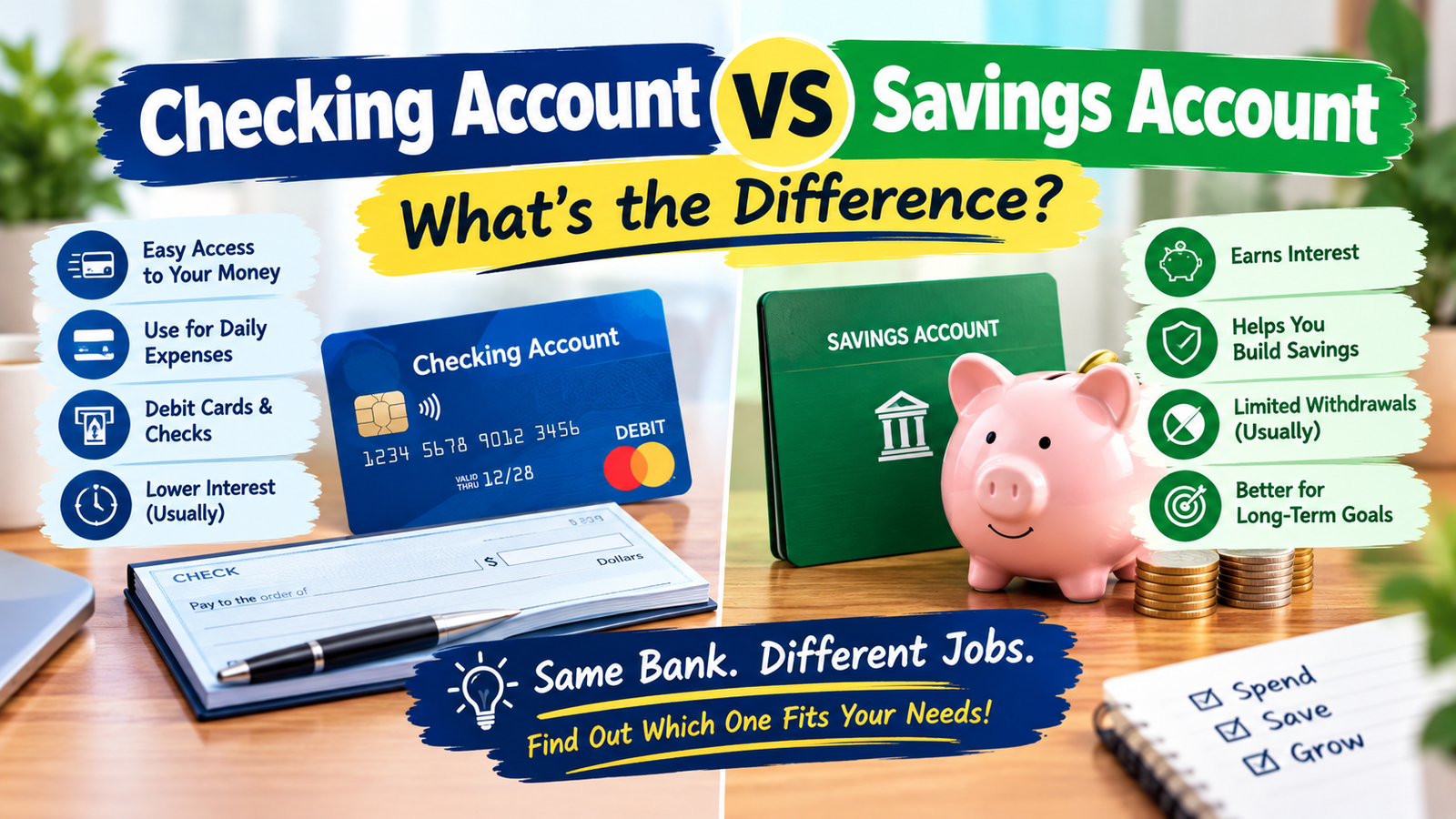
Here’s a mistake I see constantly: someone keeps their entire emergency fund sitting in a checking account “for convenience,” then wonders why their money never grows and why it’s so easy to accidentally spend it on a whim purchase. The checking account vs savings account question isn’t just banking trivia — it’s the foundation of basically every good personal finance habit that comes after it. Get this wrong, and you’re either losing out on interest or making it too easy to dip into money you meant to protect. Get it right, and the rest of your budgeting system practically runs itself.
What’s the Real Difference Between Checking and Savings?
At the core, the difference comes down to purpose: checking accounts are built for spending, savings accounts are built for holding. Everything else — interest rates, withdrawal limits, fee structures — flows from that one design decision.
Both are typically FDIC-insured (up to $250,000 per depositor, per bank) if held at a bank, or NCUA-insured at a credit union, so safety isn’t the differentiator. The differentiator is behavior: what each account is designed to make easy, and what it’s designed to make slightly harder.
Checking Accounts: Built for Movement
A checking account is a demand deposit account — meaning you can withdraw funds “on demand” without restriction. It’s designed for:
- Debit card purchases
- Bill pay and direct debits
- Check writing
- ATM withdrawals
- Direct deposit of paychecks
Checking accounts typically pay little to no interest, because banks aren’t incentivizing you to leave money sitting there — they’re facilitating transactions.
Savings Accounts: Built for Growth
A savings account is designed to hold money you’re not actively spending. In exchange for slightly reduced liquidity, it pays interest — expressed as APY (Annual Percentage Yield) — that compounds over time.
Historically, federal Regulation D limited savings accounts to six “convenient” withdrawals per month (transfers, online payments, etc.), though the Federal Reserve suspended that specific reserve requirement in 2020. In practice, many banks still enforce their own withdrawal limits or fees on savings accounts, so it’s worth checking your specific bank’s policy rather than assuming the old six-per-month rule no longer applies anywhere.
[Internal Link: “related article about how FDIC insurance actually works”]
Why This Distinction Actually Matters for Your Money
Interest Rates and Opportunity Cost
This is where the real financial stakes live. Money sitting in a typical checking account often earns close to 0% APY. Move that same money to a high-yield savings account, and depending on current rates, you could be earning a meaningfully higher return — for doing nothing except moving it to the right account type.
Over a year, on even a modest emergency fund, that gap adds up to real money you’re otherwise leaving on the table simply by keeping cash in the wrong account.
Access, Limits, and Liquidity
Checking accounts offer near-total liquidity — you can spend the money instantly via debit card or check. Savings accounts trade a little of that immediacy (occasional withdrawal limits, sometimes a 1–3 day transfer delay to move funds to checking) in exchange for the higher yield.
That friction is a feature, not a bug. In my experience, that small delay is often exactly what stops an impulse purchase from happening.
How to Use Both Accounts Together: A Simple System
Setting Up the Two-Account Structure
The system I recommend to almost everyone starting out is simple:
- Checking account — holds only what you need for the current month’s bills and spending.
- Savings account — holds your emergency fund, short-term savings goals, and any cash not immediately needed.
- Direct deposit your paycheck into checking, then automatically transfer a fixed amount to savings on payday.
Automating the Split
Most banks let you set up an automatic recurring transfer — for example, a fixed dollar amount or percentage moved to savings the day after each paycheck lands. Automating this removes the willpower problem entirely: the money moves before you have a chance to spend it.
[Internal Link: “related article about building a starter emergency fund”]
Common Mistakes People Make With These Accounts
Keeping Everything in One Account
The single most common mistake: using one account for everything. It makes it nearly impossible to track how much is “spendable” versus “saved,” and it means your savings never actually earns anything meaningful.
Chasing Interest Rates Without Reading the Fine Print
Some savings accounts advertise a high introductory APY that drops significantly after a few months, or require a minimum balance to qualify for the advertised rate. Honestly, this trips up more people than low rates do — they chase the headline number and don’t realize it’s temporary or conditional.
Forgetting About Fees
Monthly maintenance fees, minimum balance requirements, and excess withdrawal fees on savings accounts can quietly erode the benefit of moving your money in the first place. Always check the fee schedule before switching banks purely for a better rate.
Expert Tips for Getting More Out of Both Accounts
For Everyday Spenders
- Keep a buffer in checking, not your exact bill total — a small cushion (even $100–200) prevents overdraft fees from timing mismatches.
- Set up low-balance alerts so you’re notified before you’re at risk of an overdraft, rather than after.
- Use a checking account with no monthly fee — nearly every bank offers this now if you meet simple requirements like direct deposit.
For Serious Savers
- Shop for APY like you’d shop for any other financial product — don’t just default to your checking account’s bank for savings too; rates vary significantly between banks.
- Consider multiple savings “buckets” (sub-accounts or separate accounts) for different goals — emergency fund, vacation fund, etc. — so you’re not mentally lumping all your savings together.
- Reinvest interest automatically rather than transferring it out, so compounding works in your favor over time.
- Revisit your savings APY annually — rates change, and loyalty to a bank that hasn’t kept its rate competitive costs you money.
Comparison Table: Checking vs. Savings at a Glance
| Feature | Checking Account | Savings Account | High-Yield Savings Account |
|---|---|---|---|
| Primary purpose | Everyday spending | Holding money, some growth | Holding money, maximizing growth |
| Typical interest (APY) | Near 0% | Low | Meaningfully higher (varies by bank/rate environment) |
| Withdrawal frequency | Unlimited | Sometimes limited by bank policy | Sometimes limited by bank policy |
| Debit card / check access | Yes | Rarely | Rarely |
| Best for | Bills, daily spending | Emergency fund, short-term goals | Emergency fund, short-term goals, rate-sensitive savers |
| Typical fees | Monthly fee (often waivable) | Minimum balance / excess withdrawal fees | Minimum balance / excess withdrawal fees (varies) |
Who Needs Both Accounts (and Who Might Not)
Most people benefit from having both. If you have any income at all and any goal beyond immediate spending — an emergency fund, a big purchase, a vacation — separating “spending money” from “saving money” into different accounts makes the whole system easier to manage and harder to accidentally undermine.
You might not need a separate savings account if you’re extremely early in your financial life with minimal cash flow, or if you’re using an alternative savings vehicle (like a brokerage sweep account or a dedicated app-based savings tool) that already provides the same separation and yield benefits. The account type matters less than the underlying discipline of not mixing “spend” money with “save” money.
Conclusion
The checking vs. savings distinction isn’t complicated once you see it for what it is: one account is a tool for moving money out, the other is a tool for holding money in place while it grows. Keep your everyday spending in checking, automate transfers to a savings account (ideally a high-yield one) for anything you’re not spending this month, and let the friction and interest do the rest of the work. If you’re currently keeping everything in one account, that’s the single easiest change to make this week — open a separate savings account, set up one automatic transfer, and let it run.
3. FAQ Section
Q1: Can I use a savings account like a checking account?
Technically you can withdraw from a savings account, but it’s not designed for frequent transactions — many banks still limit or charge for excess withdrawals, and savings accounts typically don’t come with a debit card or check-writing ability. Using it as your primary spending account defeats its purpose and can trigger fees.
Q2: How many withdrawals am I allowed from a savings account per month?
The federal rule that historically capped withdrawals at six per month was suspended by the Federal Reserve in 2020, but many banks still enforce their own limit or charge excess withdrawal fees. Always check your specific bank’s current policy rather than assuming a universal rule applies.
Q3: Do I really need both a checking and a savings account?
In my experience, yes — even a very simple two-account setup makes budgeting dramatically easier because it separates “spendable” money from “saved” money automatically, rather than relying on mental math to track it in one pool.
Q4: Which account should my paycheck go into?
Your checking account, generally — then set up an automatic transfer to move a portion to savings right after each paycheck lands. This way saving happens automatically instead of depending on willpower at the end of the month.
Q5: Why does my savings account pay so little interest?
Traditional brick-and-mortar bank savings accounts often pay very low rates because they’re not competing aggressively for deposits. Online banks and high-yield savings accounts typically pay significantly more, since they have lower overhead and compete more directly on rate.
Q6: Is it bad to keep too much money in checking?
Honestly, yes — beyond your monthly spending buffer, money sitting in checking is money not earning meaningful interest. Anything beyond a comfortable buffer for bills is generally better parked in a savings account.
Q7: What happens if I overdraw my checking account?
Most banks charge an overdraft fee, though many have moved toward more consumer-friendly policies (grace periods, lower fees, or opt-in overdraft protection linked to a savings account). Setting up low-balance alerts is the simplest way to avoid this entirely.
Q8: Are checking and savings accounts both FDIC insured?
Yes, at FDIC-member banks both account types are insured up to $250,000 per depositor, per bank, per ownership category. Credit unions offer equivalent protection through the NCUA.
Q9: What’s a money market account, and how does it compare?
A money market account sits somewhere between checking and savings — it often pays savings-like interest while sometimes offering limited check-writing or debit card access. It’s worth comparing if you want a bit more flexibility than a pure savings account without giving up all the yield benefit.
Q10: Should I open my savings account at the same bank as my checking account?
Not necessarily. Many savers get the best rates by keeping checking at a convenient local bank for everyday access while opening a high-yield savings account at an online bank purely for the better rate — the accounts don’t need to live under the same roof.