
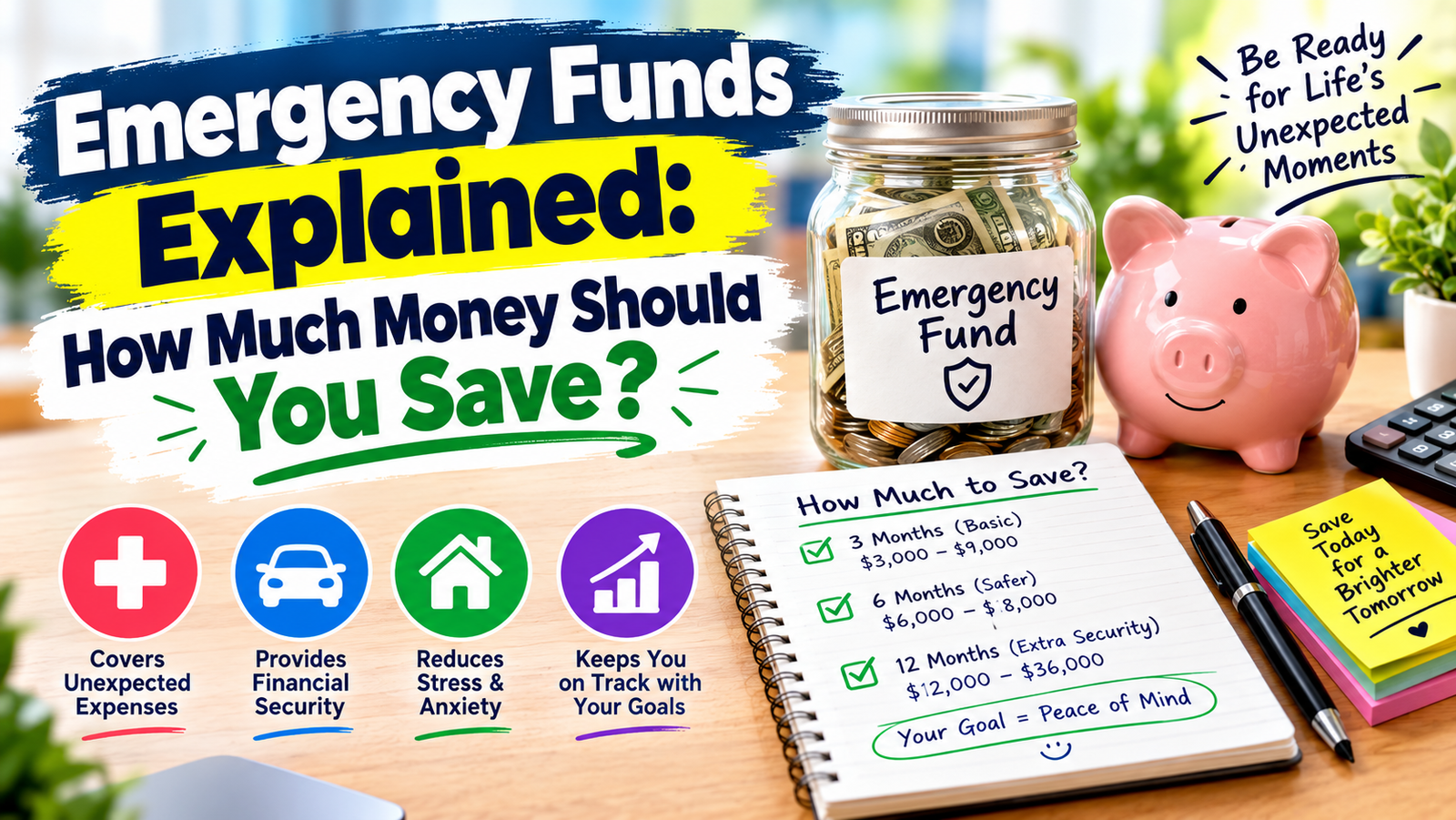
Here’s a number that should bother you. In Bankrate’s December 2025 survey, fewer than half of Americans (47%) said they had the liquidity to cover a surprise $1,000 expense. That isn’t a retirement gap or a down-payment gap. It’s a “the transmission just died” gap. bankrate
An emergency fund is the fix. It’s also the least glamorous money move you’ll ever make. Nobody gets impressed at dinner when you mention your savings account. But a funded cushion is what keeps a broken water heater from becoming a credit card balance, and a layoff from becoming a crisis.
The hard part is the question everyone asks and few answer well: how much should you actually save? Three months? Six? Twelve? “It depends” is true and useless. So in this guide you’ll get a real formula, real dollar examples, and a plan to build the thing even if you’re starting from zero.
What Is an Emergency Fund? The Real Definition
An emergency fund is a dedicated pile of cash you can reach within a day or two. It’s set aside for expenses that are unexpected, necessary, and urgent. If a purchase fails any one of those three tests, it isn’t what this money is for.
The word people skip is dedicated. Cash that happens to be sitting in your checking account isn’t an emergency fund. It’s a balance you’ll spend the moment a good sale shows up. A real emergency fund has a job, a name, and ideally its own address, meaning a separate account.
What counts as an emergency (and what doesn’t)
Counts:
- Job loss, reduced hours, or a client walking away
- Medical, dental, or vet bills your insurance doesn’t fully cover
- Essential car or home repairs, the kind that stop you from getting to work or living safely
- Emergency travel, like flying home for a family crisis
- Insurance deductibles after damage or theft
Doesn’t count:
- Holiday gifts, annual insurance premiums, car registration
- A vacation, a “limited-time” sale, a phone upgrade
- An investment opportunity that “won’t last”
My rule of thumb: if you could have spotted it on a calendar, it’s a budget line, not an emergency. Annual expenses feel like surprises only because we forget them.
Emergency fund vs. sinking fund vs. savings goal
These three get mixed up constantly, and mixing them is how emergency funds quietly disappear.
- Emergency fund: unpredictable shocks. Never spent on anything planned.
- Sinking fund: predictable but irregular costs (car registration, holiday spending, annual subscriptions). You know it’s coming; you just don’t know the month.
- Savings goal: something you want (a down payment, a wedding, a trip).
Keep them in separate buckets. If they share one balance, you’ll always feel “sort of” covered and never actually know.
[Internal Link: “how to set up sinking funds for irregular expenses”]
Why this matters right now in 2026
Bankrate’s latest report frames the moment well: sticky inflation and a softening job market are making extra money in the bank more valuable as a lifeline. Meanwhile, 54% of Americans say inflation is causing them to save less. So the need is rising while the ability to save is shrinking. That’s exactly when a plan beats good intentions. bankratebankrate
Why an Emergency Fund Matters: The Real Stakes
The numbers
Let’s start with what the data says, because it’s less comfortable than most people assume.
- Only 30% of Americans say they’d pay a $1,000-plus emergency from savings, while 33% say they’d go into debt: 17% via credit card, 12% by borrowing from family or friends, and 3% via a personal loan. bankrate
- 58% say their emergency savings haven’t grown in a year, including 29% whose savings actually fell. Only 21% report having more than a year ago. bankrate
- 29% have more credit card debt than emergency savings, versus 44% who have more savings than card debt. bankrate
- The Federal Reserve’s 2025 household survey, as summarized by Financer, found that 55% of adults had enough rainy-day savings for three months, and 63% could cover a $400 expense with cash or its equivalent. financer
That last figure has a wrinkle worth knowing. The Fed’s definition of “cash or its equivalent” includes savings, cash, and a credit card paid off at the next statement. So even the “good” $400 number is generous. Plenty of people in that 63% are one bad month from carrying a balance. ngpf
What “no cushion” actually costs
Say your car needs a $2,000 repair and you put it on a card with an APR in the low 20s. That’s roughly $37 in interest in the first month alone (2,000 × 0.22 ÷ 12). Pay only the minimum, and the repair quietly becomes a $2,600+ repair over the following years.
That’s the visible cost. The invisible one is worse. Every emergency you finance makes the next one harder, because you’re now paying interest on the last one. That’s how a single bad month becomes a bad year.
The benefit nobody puts in a spreadsheet
Here’s my honest opinion: the biggest payoff of an emergency fund isn’t the money. It’s the quality of your decisions.
People with a cushion can quit a toxic job without panic-accepting the first offer. They can negotiate salary because they can afford to walk away. They can handle a burst pipe on a Tuesday without spiraling. Cash buys time, and time buys options. Broke people make rushed decisions, and rushed decisions are expensive.
How Much Should You Save? A Step-by-Step Breakdown
The standard advice is “3 to 6 months of expenses.” It’s a decent starting point, but it’s too blunt. A tenured teacher with a working spouse and a freelance photographer with two kids shouldn’t hold the same number. Here’s the system I recommend instead.
The Three-Layer Cushion
Think in layers, not a single finish line. Each layer protects you from a different size of problem.
Layer 1: The Starter Buffer ($1,000–$2,000).
This handles the small stuff: a flat tire, a co-pay, a dead laptop. Its only job is to keep everyday surprises off your credit card. If you’re starting from zero, build this first and build it fast. It’s a 30–60 day mission, not a year-long one.
Layer 2: The Core Fund (3–6 months of essential expenses).
This is the real emergency fund. It covers a job loss or income drop long enough to find your footing. Most households should land here.
Layer 3: The Extended Cushion (6–12 months).
This is for higher-risk situations: variable income, a single earner supporting dependents, a niche career where job searches run long, or health issues that could interrupt work. It’s also insurance against a slow economy, when hiring stalls and searches stretch out.
Step 1: Calculate your essential expenses (not your total spending)
This is where most people go wrong. Size your fund off essentials, the bills you’d still pay in a crisis, not your current lifestyle.
Essentials include:
- Rent or mortgage
- Utilities and internet
- Groceries
- Transportation (gas, insurance, transit)
- Insurance premiums
- Minimum debt payments
- Phone
- Childcare or dependent care
- Essential medications and health costs
Pull your last three months of bank statements and add these up. Here’s a sample household:
| Essential | Monthly |
|---|---|
| Rent | $1,600 |
| Utilities & internet | $320 |
| Groceries | $600 |
| Transportation | $450 |
| Insurance | $380 |
| Minimum debt payments | $300 |
| Phone | $80 |
| Total | $3,730 |
At that number, three months is $11,190 and six months is $22,380. That’s a real target, not a vague “save more.”
[Internal Link: “how to calculate your essential monthly expenses”]
Step 2: Turn the Risk Dial
Start at 3 months. Then adjust.
Add 1 month for each that applies:
- You’re the only income in the household
- Your income is variable (freelance, commission, seasonal)
- Other people depend on you financially
- Your role is senior or specialized, so replacements take longer to find
- You carry high deductibles, or own an older home or car
Subtract 1 month for each that applies:
- Two stable incomes in the household
- A strong safety net: tenure, union protection, meaningful severance, or family who could realistically help
- Very low fixed costs
Take the single-income household with a child and a steady salary. That’s 3 + 1 (single income) + 1 (dependent) = 5 months. On the $3,730 example, that’s $18,650.
Most people end up between 3 and 8 months. Beyond that, you’re probably hoarding cash that would work harder elsewhere.
Step 3: Choose the right home for the money
Your emergency fund has two jobs: stay safe and stay accessible. Earning interest is a bonus, not the mission. For most people, a high-yield savings account (HYSA) at an FDIC-insured online bank is the sweet spot. Deposits are insured up to $250,000 per depositor, per bank, per ownership category, and the money is usually a transfer away within a business day or two. Rates move with the Fed, so check current offers rather than trusting any number printed in an article.
I’ve compared the main options in the table after the FAQ.
[Internal Link: “best high-yield savings accounts right now”]
Step 4: Build it without wrecking your life
Here’s the timeline math on that $11,190 core-fund target, ignoring interest:
- $250/month: about 45 months
- $400/month: about 28 months
- $700/month: about 16 months
Those first numbers look discouraging, which is exactly why you don’t rely on monthly leftovers. Use these instead:
- Automate on payday. Schedule the transfer for the day your paycheck lands. What you don’t see, you don’t spend.
- Feed it windfalls. Tax refunds, bonuses, cash gifts, a sold couch. Sending even half to the fund moves the finish line dramatically.
- Split every raise. When your pay goes up, send half of the increase straight to savings before your lifestyle adjusts.
- Run a 90-day squeeze. Temporarily cut the flexible stuff (subscriptions, dining out, impulse shopping) to hit Layer 1 quickly. Momentum matters more than perfection.
- Add a short-term income burst. Extra shifts, freelancing, or selling unused stuff can get you to your starter buffer in weeks.
[Internal Link: “how to build a monthly budget from scratch”]
Common Mistakes People Make (and How to Avoid Them)
Honestly, most people don’t fail at emergency funds because they’re lazy. They fail because of a handful of predictable errors.
1. Sizing the fund off total spending instead of essentials.
You’d cut the streaming services, the takeout, and the gym in a real crisis. Size the fund off what you’d actually pay. Otherwise the target feels impossible and you quit.
2. Leaving it in checking.
If it sits next to your debit card, it will get spent on things that feel urgent but aren’t. A separate account, ideally at a different bank, adds just enough friction.
3. Investing the whole thing.
Stocks are for money you won’t need for five-plus years. Markets often drop at the same time layoffs rise, which means your “emergency fund” could be down 25% exactly when you need it. That’s a design flaw, not a strategy.
4. Waiting for the “perfect” number.
People get stuck calculating the ideal target and never start. Start with $500. Seriously. A small fund that exists beats a perfect one that doesn’t.
5. Raiding it for non-emergencies.
Every “just this once” withdrawal trains you to treat it as spending money. Write down your three tests (unexpected, necessary, urgent) and tape them to your banking app if you have to.
6. Not replenishing after use.
Using the fund is what it’s for. Failing to refill it is the mistake. After any withdrawal, make rebuilding the fund your next financial priority.
7. Ignoring the debt interaction.
If you carry high-interest debt, a fund that’s too big can cost you more in interest than it saves in security. I cover the sequencing in the tips below.
[AUTHOR: Add a short first-hand story here about a mistake you made or watched someone make. This is the most valuable paragraph for trust and E-E-A-T, and it needs to be real.]
Expert Tips & Advanced Strategies
If you’ve read a few beginner articles, this is the stuff they skip.
1. Sequence it: starter buffer → high-interest debt → core fund.
My preferred order is a $1,000–$2,000 starter buffer first, then attack debt with an APR in the double digits, then build the core fund. There’s one exception: if your employer offers a 401(k) match, grab the match throughout. It’s an instant return you can’t beat. [Internal Link: “debt snowball vs. debt avalanche”]
2. Know your deductibles, then hold at least that much.
Look up your health insurance out-of-pocket maximum and your home and auto deductibles. Your fund should cover the largest one you might realistically face, on top of your months-of-expenses target. Insurance covers the catastrophe. Your fund covers the deductible.
3. Use tiered liquidity for big funds.
If you’re holding 8–12 months, keep 2–3 months in an instantly accessible HYSA and put the rest in slightly less liquid, low-risk options like a short CD ladder or Treasury bills. You’ll pick up some extra yield without gambling on access.
4. Rename the account.
This sounds silly and it works. Call it “Job Loss Cushion” or “Sleep-at-Night Fund” instead of “Savings.” Behavioral research on mental accounting supports the idea that labeled money is spent differently, and in my view it’s the cheapest willpower upgrade there is.
5. Pair the fund with the right insurance.
A fund can’t absorb a long-term disability or a major liability. Disability insurance, adequate health coverage, and renters or homeowners protection are what let a modest cash cushion work. Skipping insurance to build a bigger fund is trading a small risk for a big one.
6. Treat retirement-account escape hatches as a last resort, not a plan.
Roth IRA contributions (not earnings) can generally be withdrawn without tax or penalty. Federal law also now allows a limited penalty-free emergency withdrawal from many retirement accounts, capped at $1,000 a year, though the rules have conditions and it’s still taxable. Know these exist. Don’t lean on them. You’re borrowing from your future self at a bad price.
7. Re-size the fund on life events, not just annually.
New baby, new mortgage, job change, going freelance, a partner leaving the workforce: each one changes your number. Rerun the Risk Dial whenever your life changes shape.
Real Scenarios: What This Looks Like in Practice
These are composite scenarios built from common patterns, with rounded numbers to keep the math clear. They aren’t real clients.
Scenario 1: The freelancer with lumpy income
Maya, a freelance designer, has $3,200 in essential expenses and income that swings month to month. On the Risk Dial she starts at 3 and adds 2 for variable income, landing at 5 months, or $16,000.
Instead of saving “what’s left,” she moves 10% of every client payment into a separate account the day it arrives. In strong months the fund jumps; in slow months it barely moves, and that’s fine. Over roughly a year and a half she reaches the target. When a large client leaves the following year, she has months to replace the income instead of days.
Scenario 2: The dual-income household with credit card debt
The Ortiz family has two salaries, $4,600 in essentials, and $7,000 on a credit card. They build a $1,500 starter buffer first, then throw every spare dollar at the card until it’s gone. Only then do they build the core fund toward four months (3 for the baseline, +1 for their two young kids, −0 for their otherwise ordinary risk).
The debt-first middle step cost them a slower cushion, but they saved a meaningful chunk in interest, and the freed-up card payment became the fuel for the fund itself.
Scenario 3: The new graduate on a tight budget
Sam, an early-career employee with $2,400 in essentials, starts with a $1,000 starter buffer. He automates $150 per pay period, sends half of his first raise to savings, and reaches a full month of essentials, then three, without ever “feeling” a big sacrifice.
The lesson across all three: the plan flexes to the person, but the mechanics (automation, separation, right-sizing) stay the same.
[AUTHOR: If you have a real anecdote or result of your own, swap it in here with real dates, amounts, and outcomes.]
Who should follow this approach, and who shouldn’t
This approach is a great fit if:
- You have no cushion, or a thin one, and don’t know your number
- You rely on one income or have variable income
- You’ve been using credit cards as your de facto emergency fund
Adjust it, or get personal advice, if:
- You’re carrying high-interest debt. A full 6-month fund may need to wait behind a starter buffer, as covered above.
- You have a very high net worth. A rigid “months of expenses” rule matters less when you have deep liquid assets.
- You’re nearing or in retirement. Sequence-of-returns risk and withdrawal planning change the math; a professional can help.
- You’re in true financial hardship. Sometimes the first job is stabilizing income or accessing assistance, not saving. Saving $50 a month while missing rent doesn’t help.
- You have unusual risk. Self-employed business owners, people with chronic health conditions, or anyone with major uninsured exposure may need a larger or differently structured cushion.
I’m not a licensed financial advisor, and nothing here is personalized advice. If your situation is complicated, a fee-only fiduciary planner is worth the hour.
Conclusion: Build the Cushion Before You Need It
Here’s what I’d want you to walk away with. An emergency fund isn’t about being cautious. It’s about buying yourself time and better choices when life gets expensive.
Aim for 3–6 months of essential expenses, then turn the Risk Dial up or down for your own situation. Start with a $1,000–$2,000 starter buffer this month. Keep the money in a separate, insured, easy-to-reach account. Automate the deposits, and treat the fund like a fire extinguisher: you don’t spend it on convenience, and you refill it after every use.
Don’t wait for the perfect number. Tonight, do two things: add up your essential monthly expenses, and open (or rename) a separate savings account for this. That’s ten minutes, and it’s the difference between reading about an emergency fund and having one.
Then tell me in the comments: what’s your target number, and what’s the biggest obstacle to reaching it? I read every one.
4. Comparison Table: Where Should You Keep Your Emergency Fund?
| Option | Access speed | Safety | Yield potential | Best for | Cost / difficulty |
|---|---|---|---|---|---|
| Traditional savings account | Instant to 1 day | FDIC/NCUA-insured (up to limits) | Usually very low | Beginners who want simplicity | Easy, but often earns little |
| High-yield savings account (HYSA) | 1–3 business days (transfer) | FDIC/NCUA-insured (up to limits) | Competitive, variable | Most people’s core fund | Easy; shop rates periodically |
| Money market account (bank) | 1–2 days; some offer check or debit access | FDIC/NCUA-insured (up to limits) | Similar to HYSA, often variable | People who want check-writing access | Easy; watch minimum balances and fees |
| CD ladder | Locked until maturity; early-withdrawal penalty | FDIC/NCUA-insured (up to limits) | Often higher, fixed for the term | Extended cushion (Layer 3), not the first layer | Moderate; requires planning |
| Treasury bills / money market fund (brokerage) | 1–3 business days to settle | T-bills backed by the U.S. government; money market funds aren’t FDIC-insured | Competitive, tracks short-term rates | Larger cushions and tax-aware savers | Moderate; brokerage account needed |
My take: For most people, an FDIC-insured HYSA is the right default. Layer in CDs or T-bills only if you hold a larger extended cushion and are comfortable with slightly slower access.
[Internal Link: “money market account vs. high-yield savings account”]
5. FAQ Section
Q: How much money should I have in an emergency fund?
A: Most people should aim for three to six months of essential expenses, meaning the bills you’d still pay in a crisis. If your household has one income, variable income, dependents, or a specialized job, lean toward six months or more. If you have two stable incomes and a strong safety net, three may be enough. If you’re starting from scratch, begin with a $1,000–$2,000 starter buffer, then build up. The right number depends on your risk, not a universal rule.
Q: Is $1,000 enough for an emergency fund?
A: A $1,000 emergency fund is a solid starting point, not a finish line. It’s enough to absorb common small shocks like a flat tire, a co-pay, or a minor appliance repair without touching a credit card. It won’t get you through a layoff or major medical event. My opinion: treat $1,000 as Layer 1, hit it fast, then keep building toward three to six months of essentials so you’re covered for the bigger stuff.
Q: How many months of expenses should an emergency fund cover?
A: Three to six months is the common range. Go toward three if you have two stable incomes, strong job security, and low fixed costs. Go toward six or more if you’re the sole earner, self-employed, work in a niche field where job searches run long, or support dependents. Base the number on essential expenses (housing, food, utilities, insurance, transport, minimum debt payments), not your full lifestyle spending. Recalculate whenever your life changes.
Q: Where should I keep my emergency fund?
A: Keep it somewhere safe, separate, and easy to reach. For most people, that means a high-yield savings account at an FDIC- or NCUA-insured institution. Deposits are insured up to $250,000 per depositor, per institution, per ownership category, and transfers typically arrive within a couple of business days. Avoid the stock market for this money. I also recommend keeping it at a different bank from your checking account, because that small bit of friction discourages casual spending.
Q: Should I pay off debt or build an emergency fund first?
A: My recommended order is a small starter buffer ($1,000–$2,000) first, then attack high-interest debt, then build the full fund. The starter buffer keeps small surprises from landing back on your credit card. Once your debt is tamed, you can grow the core fund with far less risk. The exception is an employer 401(k) match, which is usually worth capturing throughout. Personal situations vary, so a licensed advisor can help if you’re unsure.
Q: What counts as an emergency?
A: A true emergency is unexpected, necessary, and urgent. Think job loss, urgent medical bills, essential car or home repairs, or emergency travel for a family crisis. Predictable expenses like annual insurance premiums, holiday gifts, or car registration belong in a sinking fund. Wants like vacations, sales, or gadget upgrades don’t qualify. My personal rule: if you could have seen it coming on a calendar, it isn’t an emergency, it’s a budgeting problem.
Q: Can I invest my emergency fund?
A: I wouldn’t. Investments can drop in value at the same time job losses rise, so your safety net could shrink exactly when you need it. Your emergency fund should prioritize safety and access over growth. Keep it in insured cash-like accounts such as a high-yield savings account. If you have a large extended cushion beyond your core fund, low-risk options like short-term Treasury bills or CDs can add a little yield without exposing it to market swings.
Q: How long does it take to build an emergency fund?
A: It depends on your target and savings rate. On a sample $11,190 target (three months of $3,730 in essentials), saving $250 a month takes about 45 months; $400 takes roughly 28; $700 takes about 16. Automating deposits, sending windfalls like tax refunds, and splitting raises can shorten that a lot. Aim to hit a $1,000–$2,000 starter buffer within one or two months for early momentum.
Q: Do I still need an emergency fund if I have a credit card?
A: Yes. A credit card is a loan, not savings, and using it for emergencies means paying interest at a typical rate in the low 20s. It can also be reduced or closed exactly when your finances are strained. Bankrate’s data shows about a third of Americans would go into debt to cover a $1,000 emergency, which is the pattern an emergency fund is meant to break. I treat a credit line as a backup to the cushion, never as a replacement.
Q: How do I build an emergency fund on a low income?
A: Start small and automate. Even $10–$25 per paycheck adds up, and a first goal of $500 is a real win. Send windfalls like tax refunds or cash gifts to the fund, and trim one or two flexible expenses temporarily. Look into short-term income boosts like extra shifts or selling unused items. If bills are already going unpaid, contact a nonprofit credit counselor or local assistance programs first. Stabilizing your income can matter more than saving in the short term.