
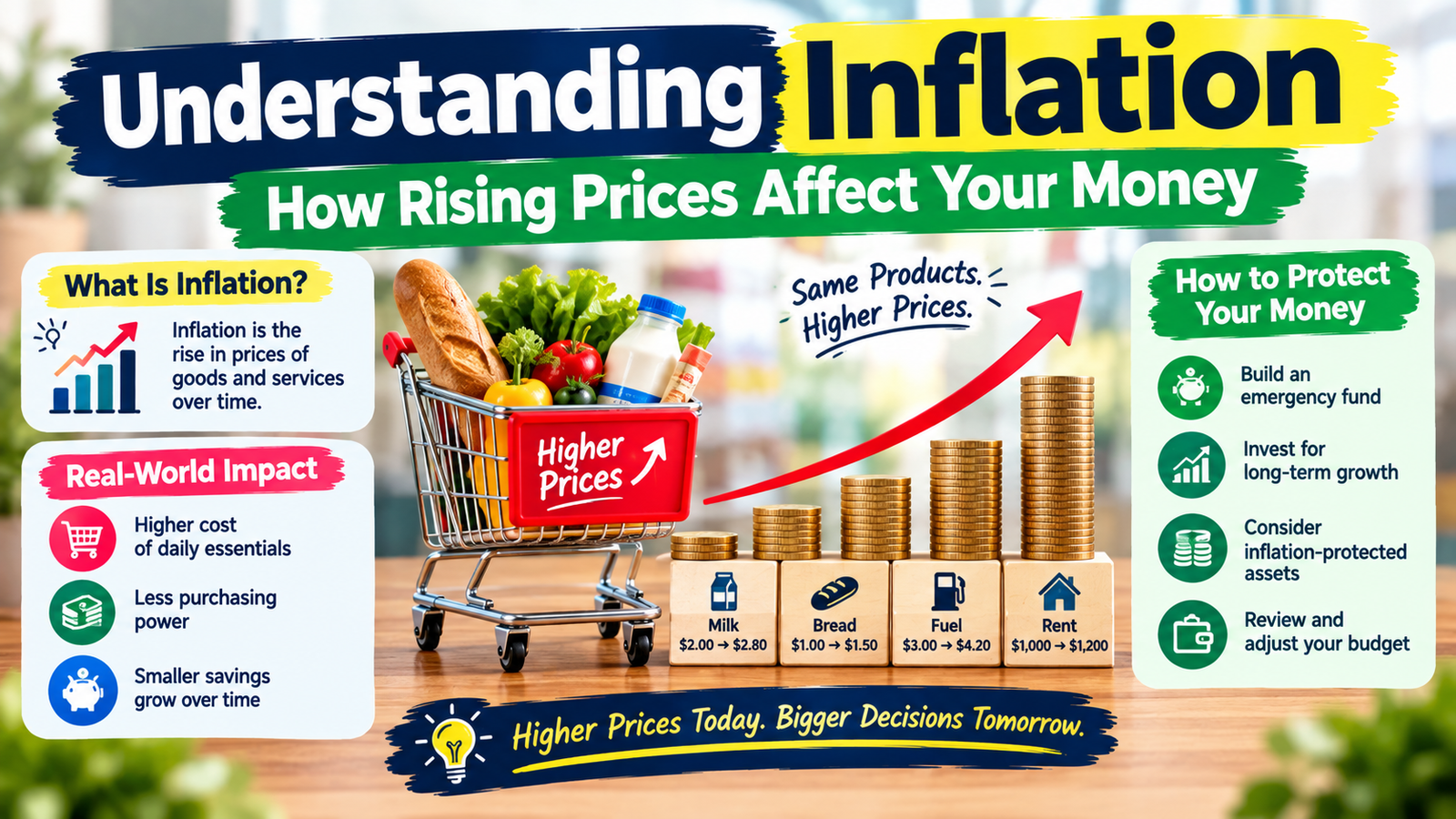
Here’s the thing about inflation that nobody quite grasps until it hits their grocery bill: your money didn’t lose value all at once. It happened a few cents at a time, month after month, until one day you’re paying noticeably more for the exact same cart of groceries you bought two years ago. Understanding inflation isn’t just an economics-class concept — it’s the difference between your savings actually growing and your savings quietly shrinking while the number on the screen stays the same. As of August 2026, the annual U.S. inflation rate sat at 3.4%, still well above the Federal Reserve’s 2% target, according to the Bureau of Labor Statistics. That gap between “where it is” and “where the Fed wants it” is exactly why this topic isn’t going away anytime soon.
What Is Inflation, Really? Beyond the Textbook Definition
Inflation is the rate at which the general price level of goods and services rises over time, which — this is the part people forget — means the purchasing power of each dollar falls. It’s not that things get “more valuable.” It’s that your dollar gets less powerful.
How the Consumer Price Index (CPI) Actually Measures It
The Bureau of Labor Statistics tracks inflation primarily through the Consumer Price Index (CPI), which measures the average change in prices paid by consumers for a fixed “basket” of goods and services — housing, food, transportation, medical care, and more. When you hear “inflation is 3.4%,” that’s the year-over-year percentage change in that basket’s total cost.
Headline vs. Core Inflation
You’ll often see two numbers reported side by side: headline inflation (everything in the basket) and core inflation (everything except food and energy, which are volatile and swing for reasons unrelated to broader economic trends). As of August 2026, core CPI was running at 2.4% year-over-year — the lowest reading since March 2021 — even while headline inflation held at 3.4%, largely because gasoline and fuel oil prices had climbed sharply. That gap matters: it tells you whether price pressure is broad-based or concentrated in a few volatile categories.
[Internal Link: “related article about how the Federal Reserve sets interest rates”]
Why Inflation Matters to Your Wallet Right Now
The Purchasing Power Problem
Here’s the practical stakes: if inflation runs at 3.4% annually and your income doesn’t rise at least that much, you’re effectively taking a pay cut every year — even though the number on your paycheck stayed flat or even went up slightly. In my experience, this is the single hardest inflation concept for people to internalize, because nothing about their bank balance visually signals the loss.
Why Your Savings Account Might Be Losing Money
If your savings account pays 1% APY and inflation is running at 3.4%, your money’s real return is negative — roughly -2.4% once you account for lost purchasing power. This is why comparing your savings rate to the current inflation rate matters far more than just comparing it to what your account paid last year.
[Internal Link: “related article about APR vs APY and how compounding works”]
How Inflation Actually Works: The Mechanics
Demand-Pull vs. Cost-Push Inflation
Economists generally split inflation into two broad causes:
- Demand-pull inflation — too much money chasing too few goods. When consumer demand outpaces supply, prices rise to balance the two.
- Cost-push inflation — rising costs for producers (raw materials, labor, energy) get passed on to consumers as higher prices, even without a demand surge. The gasoline-driven headline spike in mid-2026 is a textbook example of this pattern.
The Federal Reserve’s Role
The Federal Reserve manages inflation primarily by adjusting the federal funds rate. Raising rates makes borrowing more expensive, which cools spending and investment, which in turn slows price growth. Lowering rates does the opposite. The Fed’s long-standing target is 2% annual inflation — a number chosen because it’s low enough to preserve purchasing power while still giving the economy room to grow.
Common Mistakes People Make When Thinking About Inflation
Ignoring the Difference Between Nominal and Real Returns
The most common mistake: looking only at the nominal return on an investment or savings account without subtracting inflation to find the real return. A 4% return sounds great — until you realize inflation ate 3.4% of it, leaving you with a real gain of roughly 0.6%.
Panic-Reacting to Headline Numbers
Honestly, most people overreact to a single month’s headline CPI print without checking whether it’s driven by a volatile category (like energy) or a broader trend. One elevated month doesn’t necessarily signal a sustained inflationary spiral — that’s exactly why economists watch core inflation alongside the headline number.
Assuming Cash Is “Safe”
Cash sitting under a mattress — or in a non-interest-bearing checking account — isn’t neutral. It’s actively losing purchasing power every single year inflation runs above 0%, which it almost always does.
Expert Strategies for Protecting Your Money From Inflation
For Savers
- Compare your account’s APY to the current inflation rate, not just to what it paid last year — if your real return is negative, it’s worth shopping for a better rate.
- Consider Series I Savings Bonds, which are specifically designed with a rate that adjusts based on inflation, making them a direct inflation hedge for cash you don’t need immediately.
- Avoid keeping excess cash reserves beyond your emergency fund in low-yield accounts — every dollar sitting idle above what you need for safety is a dollar quietly losing value.
For Investors
- Historically, equities have outpaced inflation over long time horizons, though not consistently year to year — this is a long-term strategy, not a hedge against a single bad year.
- TIPS (Treasury Inflation-Protected Securities) adjust their principal value based on CPI changes, making them a more direct — if lower-yielding — inflation hedge than standard bonds.
- Diversify across asset classes rather than betting on any single “inflation hedge” — commodities, real estate, and equities each respond differently to inflationary periods, and no single asset protects you in every scenario.
- Revisit your budget’s line items annually, not just your investments — inflation hits categories unevenly (shelter and food often run persistently above the headline number), so your personal inflation rate may differ from the national average.
Comparison Table: Common Inflation-Protection Options
| Feature | Series I Savings Bonds | TIPS | High-Yield Savings | Broad Equity Index Funds |
|---|---|---|---|---|
| Inflation adjustment | Direct (rate tied to CPI) | Direct (principal adjusts with CPI) | Indirect (bank sets rate manually) | Indirect (historical outpacing, not guaranteed) |
| Risk level | Very low | Low | Very low | Moderate to high |
| Liquidity | Locked 1 year minimum; penalty before 5 years | Tradeable, but value fluctuates | High (accessible anytime) | High, but value fluctuates |
| Typical time horizon | Medium-term (1–5+ years) | Medium to long-term | Short-term / emergency fund | Long-term (5+ years) |
| Best for | Inflation-specific short/medium savings | Inflation-conscious bond allocation | Emergency fund, near-term cash | Long-term growth beyond inflation |
Who Feels Inflation Most (and Who’s More Insulated)
Inflation hits hardest for people on fixed incomes (retirees relying on pensions or fixed annuities), lower-income households (who spend a larger share of income on necessities like food and shelter — categories that have run persistently above headline inflation), and anyone holding large cash reserves in low-yield accounts.
Inflation is less damaging for people with income that adjusts with cost-of-living increases, those holding assets that historically outpace inflation over time (like diversified equities or real estate), and borrowers with fixed-rate debt — since inflation actually makes fixed debt payments “cheaper” in real terms over time as wages and prices rise around a locked-in payment.
Conclusion
Inflation isn’t an abstract economic headline — it’s a constant, quiet force acting on every dollar you hold, every account you’re not actively managing, and every “safe” cash position you assume is neutral. The core takeaways: track your real return, not just your nominal one; understand whether current price pressure is broad or concentrated in volatile categories like energy; and make sure at least part of your savings and investments are structured to keep pace with — or outpace — inflation rather than quietly losing to it. Check your own savings account’s APY against the current inflation rate this week. If the gap is negative, that’s your sign to make a change.
3. FAQ Section
Q1: What is a “good” inflation rate?
The Federal Reserve targets 2% annual inflation as the sweet spot — low enough to preserve purchasing power, but high enough to avoid deflation risks. Anything meaningfully above that, like the 3.4% reading in August 2026, signals the Fed’s target hasn’t yet been fully achieved.
Q2: Why does inflation happen every year, even in a healthy economy?
Some mild, steady inflation is actually considered normal and even healthy — it encourages spending and investment rather than cash hoarding. Problems arise when inflation runs persistently above target or spikes suddenly, eroding purchasing power faster than incomes adjust.
Q3: How does inflation affect my savings account?
If your savings account’s APY is lower than the current inflation rate, your money is losing real purchasing power even as the account balance grows. In my experience, this is the most overlooked math in personal finance — people celebrate the interest they earned without checking whether it actually kept pace with rising prices.
Q4: What’s the difference between inflation and the cost of living?
Inflation is the broad, measured rate of price increases across the economy (via CPI). Your personal cost of living is how those price changes actually affect your specific spending — which can run higher or lower than the national average depending on where you live and what you buy.
Q5: Can inflation ever be good for me personally?
Yes, in specific cases — if you hold fixed-rate debt (like a fixed mortgage), inflation effectively makes your payment “cheaper” in real terms over time, since your income and general prices rise around a locked-in number.
Q6: What causes inflation to spike suddenly?
Sudden spikes are often driven by supply shocks (like the energy price surges seen in 2026) or supply chain disruptions, rather than broad demand-side pressure. That’s part of why economists separate headline inflation from core inflation — to isolate whether a spike is temporary or structural.
Q7: How can I tell if inflation is slowing down?
Watch core inflation (excluding food and energy) rather than the headline number — it strips out the most volatile categories. As of August 2026, core CPI had fallen to its lowest level since March 2021, even while headline inflation held steady due to energy price increases.
Q8: Should I be worried about hyperinflation in the U.S.?
Honestly, no — hyperinflation (extreme, runaway price increases, typically defined as 50%+ per month) is a fundamentally different phenomenon from the moderate inflation the U.S. has experienced, and it’s historically associated with severe currency or governance crises, not the kind of gradual price growth discussed here.
Q9: Does raising interest rates actually lower inflation?
Yes, generally — higher rates make borrowing more expensive, which cools consumer spending and business investment, reducing demand-side pressure on prices. It’s a blunt tool though, and it takes months to show up in the data, which is why Fed policy changes aren’t felt immediately.
Q10: What’s the best inflation hedge for an average person?
There’s no single “best” hedge — I generally recommend a combination: keep emergency savings in the highest-yield account you can find, consider I-bonds for medium-term inflation-specific savings, and lean on long-term diversified investments for anything with a multi-year horizon.